
Zelle Scam Evidence Texas Court: What Proof Wins?
Learn which app records, messages, bank statements, and timelines can prove a payment-app dispute in Texas court.
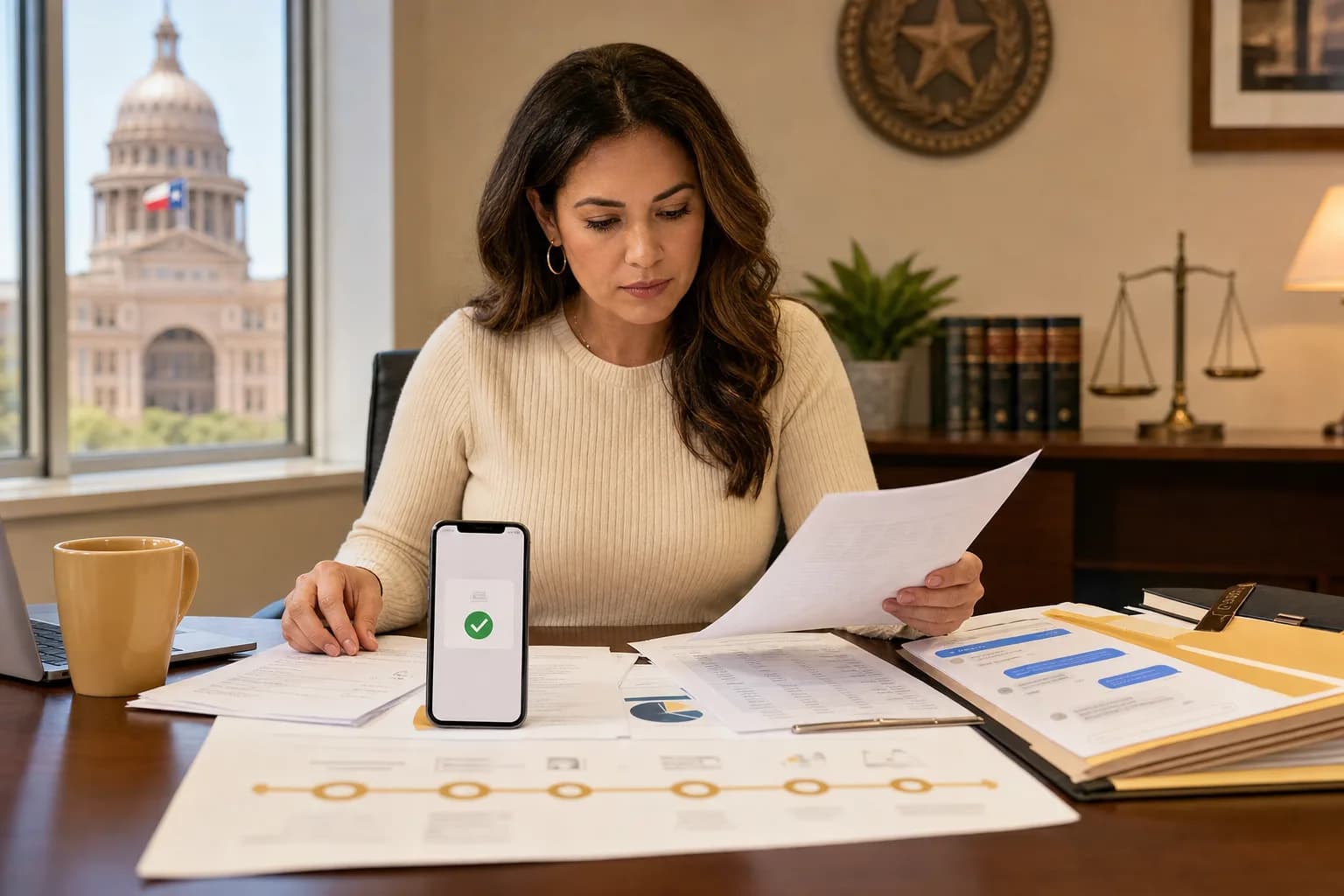
The strongest Zelle scam evidence Texas court judges can evaluate usually combines payment records, bank statements, messages, and a clear timeline showing why the money should be returned. A transaction screenshot proves that money moved, but it rarely proves by itself whether the payment was a loan, an unauthorized transfer, or payment for something never delivered.
Your goal is to connect four facts: who received the money, why it was sent, what the recipient or bank promised, and exactly how much you lost. Texas small claims cases are heard in Justice Court, where the amount in controversy can be up to $20,000, excluding interest and court costs.
💡 The basic evidence formula
Show the agreement or unauthorized activity, prove the transfer, document what happened afterward, and calculate the unpaid loss. Several records that confirm one another are usually more persuasive than one isolated screenshot.
What Zelle scam evidence does a Texas court need?
A judge needs reliable evidence that answers the entire story, not just proof that you sent money. Start by identifying the type of dispute because each type requires a different factual connection.
- Loan dispute: Prove the transfer was a loan, the other person agreed to repay it, repayment became due, and a balance remains.
- Unauthorized transfer: Prove you did not initiate or approve the transfer, reported it promptly, and suffered a loss after any credits or reimbursements.
- Payment for undelivered property: Prove what the seller promised, what you paid or traded, the delivery deadline, and the failure to deliver or refund.
- Impersonation or spoofing scam: Prove what the scammer represented, how that statement caused the payment, and the identity of the person or business legally responsible.
Collect the complete transaction record
Open the payment inside Zelle, Cash App, Venmo, Apple Pay, or your bank's application. Save the transaction date, amount, status, confirmation number, recipient name, username, phone number, email address, and any memo attached to the transfer.
Download an official transaction history when the service offers one. Screenshots are useful, but an export, account statement, or confirmation email can show that the screenshot matches a record maintained by the service.
Match the app record to your bank statement
Highlight the corresponding withdrawal on your bank or card statement. The amount and date should match the app record, although posting dates sometimes differ by a day or more.
Keep the full statement available, but prepare a copy with unrelated account numbers and transactions redacted if the court permits it. Never alter the transfer at issue, and keep the original unredacted record in case the judge asks to review it.
Which payment app records for court prove your claim?
Payment app records for court become much stronger when they are paired with messages explaining the transfer. Preserve texts, emails, app messages, marketplace listings, receipts, contracts, and voice messages in their original form whenever possible.
How to prove a payment-app loan
A transfer alone does not establish a loan because the recipient may claim it was a gift or payment for something else. To prove a Venmo loan in small claims court, look for messages using words such as "borrow," "loan," "pay you back," or a specific repayment date.
A partial repayment can be especially useful. For example, if a borrower received several electronic transfers, repaid a small amount, and later denied the balance, present the original transfers, the repayment, and messages connecting that repayment to the debt.
- Messages sent before the transfer explaining that the money was a loan
- The borrower's promise to repay on a specific date or in installments
- Payment memos describing the transaction as a loan
- Any partial payment and the message accompanying it
- Later requests for more time or admissions that money remains owed
- A simple calculation subtracting every repayment from the amount lent
The same approach applies to an Apple Pay loan not repaid in Texas. The brand of payment service matters less than evidence showing mutual understanding, receipt of the funds, the repayment obligation, and the unpaid balance.
What is strong Cash App scam proof in Texas?
Strong Cash App scam proof in Texas connects the recipient's account to a false promise or undelivered item. Save the seller's profile, $Cashtag, advertisement, product description, promised delivery date, transaction receipt, and every message requesting delivery or a refund.
If a seller accepted both an electronic payment and a trade-in but never delivered the promised vehicle, document both parts of the deal. Useful evidence can include the advertisement, vehicle identification number, title discussions, trade-in description, photos, delivery promises, proof of payment, and evidence of the trade-in's reasonable value.
Do not count the same loss twice. A damages sheet should separately list the cash transferred, the value of property surrendered, credits received, and any refund already issued.
Not sure whether your messages and payment records support a Texas small claims case? Use Flash Justice's free 5-minute AI-guided case assessment to organize the facts and identify your next step.
Start NowHow do you prove an unauthorized bank transfer?
An unauthorized transfer case turns on whether you approved the transaction. Evidence should show that someone accessed the account or initiated the payment without your permission, followed by proof of when and how you notified the bank.
This is different from a scam in which you personally pressed "send" because someone deceived you. A bank may argue that a transfer was authorized even when it resulted from fraud, so an unauthorized bank transfer lawsuit in Texas may involve federal electronic-transfer rules, account agreements, arbitration terms, and technical evidence.
Preserve the fraud report and the bank's response
Save the date and time you discovered the transaction, screenshots of security alerts, password-reset emails, unfamiliar device notices, and records of calls or secure messages to the bank. Ask for written confirmation of your fraud claim, its case number, any provisional credit, the investigation result, and the reason for denial.
- The statement containing the disputed transfer
- Fraud-report confirmation and claim number
- Letters approving or denying reimbursement
- Login or device alerts showing unfamiliar access
- Proof that you changed passwords or froze the account
- Police, FTC, or identity-theft reports, if made
- A copy of the applicable account agreement
⚠️ Report unauthorized transfers immediately
Federal rules can make prompt notice important, including deadlines tied to discovering a lost access device or receiving a statement containing an error. Contact the financial institution immediately and follow up in writing. If the bank denies a significant or complicated claim, consider consulting an attorney about the Electronic Fund Transfer Act and any arbitration provision.
A police or FTC report helps show that you consistently reported the incident, but it does not automatically prove that the bank or another defendant is legally responsible. Pair the report with account records and evidence addressing authorization.
How should you organize payment evidence for the judge?
Arrange your exhibits in chronological order so a judge can understand the dispute without searching through your phone. Keep original digital records, but create a clean exhibit packet that can be read on paper or from the court's electronic system.
Create a one-page damages timeline
Your timeline should list each important date, event, payment, and supporting exhibit. It should begin with the agreement or unauthorized activity and end with the current unpaid loss.
- Identify when the agreement was made or the suspicious activity began.
- List every transfer with its date, amount, service, recipient identifier, and confirmation number.
- Add promised repayment, delivery, or refund dates.
- Record partial repayments, returned property, credits, or reimbursements.
- Show when you demanded payment or reported the fraud.
- Calculate the exact principal loss remaining on the filing date.
Number each exhibit and refer to that number in the timeline. For example, Exhibit 1 could be the agreement messages, Exhibit 2 the Zelle confirmation, Exhibit 3 the bank statement, and Exhibit 4 the recipient's promise to repay.
Preserve context and identify the people in messages
Do not submit only one cropped line saying, "I will repay you." Include enough of the conversation to show the phone number or username, the date, what payment was being discussed, and how you know the sender was the defendant.
Be prepared to explain personally how the records were created or received. You might testify that you sent the transfer from your account, regularly communicated with the defendant at that number, and captured the screenshots from your phone.
Texas Justice Courts use simplified procedures, but the judge still decides whether evidence is reliable and relevant. Bring the original device if practical, follow the specific court's exhibit instructions, and prepare copies for the judge, the defendant, and yourself unless the court directs otherwise.
What should you do before filing in Texas Justice Court?
First, identify the correct defendant. A username is not enough for service of process. Find the recipient's legal name and an address where that person or business can be served, and distinguish the scammer from the bank or payment platform.
Second, send a clear written demand stating the amount owed, the reason, a reasonable payment deadline, and where payment should be sent. Keep proof of delivery. A demand can encourage settlement and document that the other side had an opportunity to fix the problem.
Third, review any contract or app terms for arbitration, venue, or dispute procedures. Suing Zelle, Cash App, a bank, or another platform is legally different from suing the person who received and kept the money.
Do not wait until records disappear. In Texas, claims involving debt, breach of contract, or fraud often have limitation periods measured in years, but the exact deadline depends on the legal claim and when it accrued. Some consumer claims can have shorter deadlines, so consult an attorney if timing is uncertain.
Good Zelle scam evidence Texas court judges can follow is specific, complete, and organized. Present the agreement or lack of authorization, prove where the money went, document every response, and finish with a damages calculation that does not overstate the loss.
Frequently Asked Questions
Are Zelle screenshots enough to win in Texas small claims court?
Usually, Zelle screenshots are not enough by themselves because they show a transfer but may not show why it was made. Add bank statements, complete messages, transaction identifiers, repayment promises, and evidence of the unpaid balance.
Can I sue someone who borrowed money through Cash App?
Yes, a personal loan can potentially be pursued in Texas Justice Court if the amount is within the court's $20,000 limit, excluding interest and court costs. You still need to prove that the transfer was a loan rather than a gift and that repayment is overdue.
Can text messages prove a Venmo or Apple Pay loan?
Yes, text messages can help prove the loan if they identify the parties, amount, repayment promise, and due date. Preserve the complete conversation and be ready to explain how you know the messages came from the borrower.
Can I sue my bank for refusing to refund an unauthorized transfer?
A claim may be possible, but liability depends heavily on whether the transfer was unauthorized, when you reported it, and the governing account agreement and federal law. Bank disputes may also be subject to arbitration, so consider speaking with an attorney before filing.
What damages can I request for an undelivered online purchase?
You can generally request the proven financial loss caused by the failed transaction, subject to the legal basis of your claim. Show the purchase price, the value of any trade-in, credits received, and documented related losses without counting the same damage twice.
How much can I sue for in Texas small claims court?
Texas Justice Court can hear civil claims involving up to $20,000, excluding interest and court costs. Filing fees and service costs vary by county, and you must provide evidence supporting the amount requested.
**Disclaimer:** Flash Justice is not a substitute for the advice of an attorney, and does not establish an attorney-client relationship. Flash Justice does not provide legal advice and does not exercise legal judgment on your behalf. This article is for informational purposes only. If you are unsure whether small claims court is right for your situation, we recommend consulting with a licensed attorney.
Related Articles

Contractor Ignored Demand Letter Texas: What Comes Next
Learn what to do after a contractor ignores your demand, from filing and service through the answer deadline and default judgment.
Service Never Completed Refund Texas: What Can I Sue For?
Learn which damages Texans may claim when a business takes payment, performs no service, and refuses a refund.

Sue At-Fault Driver Texas: Justice Court Filing Guide
Follow the steps for suing an at-fault driver in Texas Justice Court for vehicle damage and related losses.