
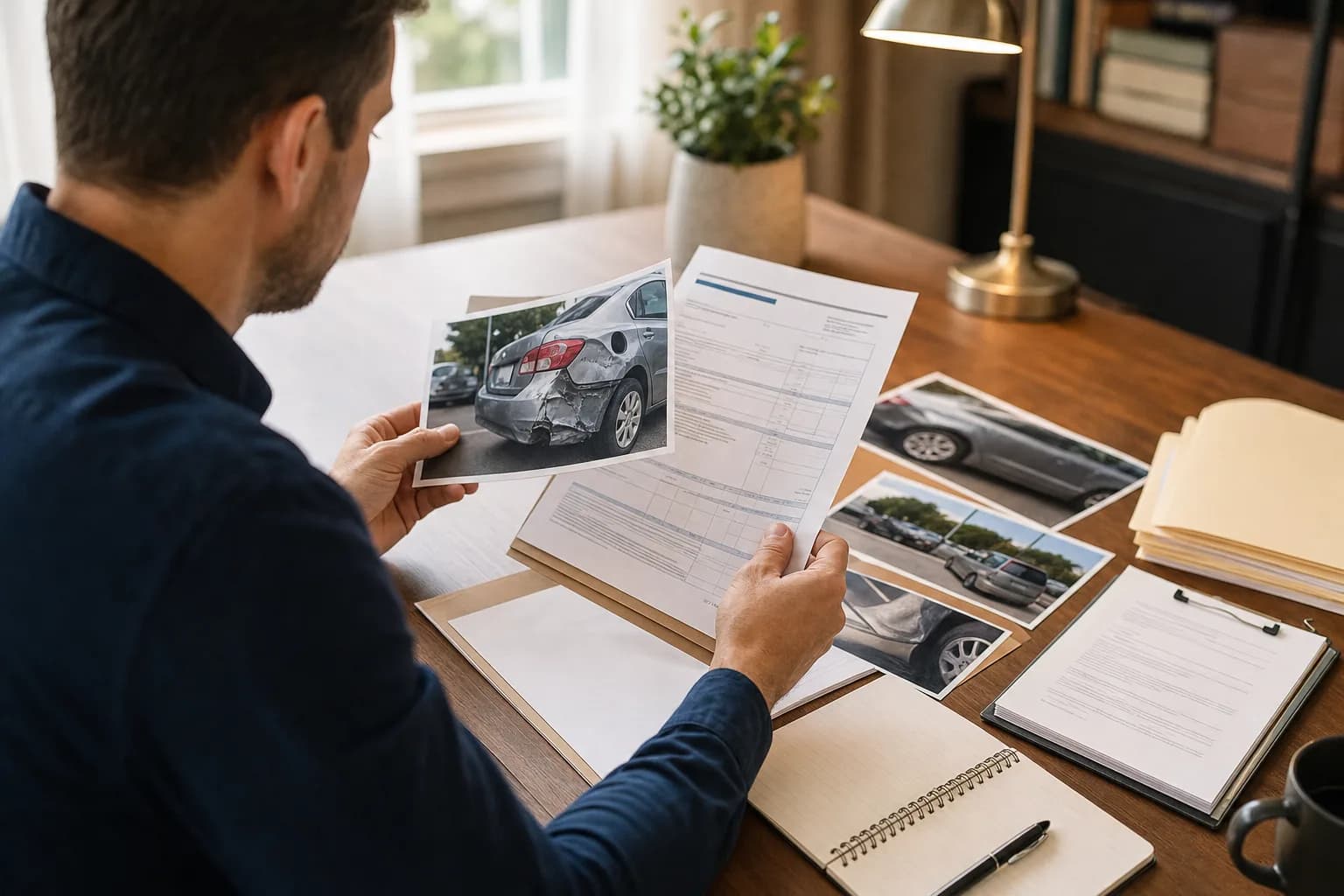
Sue At-Fault Driver Texas: Justice Court Filing Guide
Follow the steps for suing an at-fault driver in Texas Justice Court for vehicle damage and related losses.
If you need to sue an at-fault driver, Texas Justice Court may provide a practical path for recovering up to $20,000, excluding interest and court costs. You can seek compensation for vehicle repairs, a totaled vehicle, diminished value, loss of use, and an insurance deductible that remains unpaid.
The basic process is to identify the responsible person or business, choose the correct Justice Court, prepare and file a petition, arrange formal service, and present evidence at a hearing. The driver is usually the defendant, not the driver's insurance company.
This guide focuses on property damage claims, including uninsured drivers, drivers who promised to pay and stopped responding, and hit-and-run drivers who were later identified.
Can You Sue an At-Fault Driver in Texas Justice Court?
Yes. A Texas small claims car accident case is generally filed as a civil case in Justice Court, which is the court presided over by a justice of the peace. The amount in controversy cannot exceed $20,000, excluding interest and court costs.
Your case must establish that the defendant was legally responsible for the collision, that the collision caused your losses, and that the amount you are requesting is supported by evidence. A denied insurance claim or an unpaid promise does not prove those points by itself.
What vehicle-related damages can you request?
Your requested amount should reflect losses caused by the accident without duplicating amounts already paid by insurance. Depending on the facts, recoverable property damages may include:
- Reasonable and necessary vehicle repair costs.
- The vehicle's pre-accident fair market value, less applicable salvage value, if the vehicle was a total loss.
- Diminished value when a properly repaired vehicle is worth less because of its accident history.
- Reasonable loss-of-use damages for the time reasonably required to repair or replace the vehicle.
- Towing, storage, rental vehicle, rideshare, or other transportation expenses caused by the collision.
- Damage to personal property inside the vehicle.
- Your unpaid insurance deductible, as part of the property loss not reimbursed by your insurer.
- Filing and service expenses that the court awards as court costs.
Do not request the full repair bill if your insurer already paid most of it. If insurance paid $6,000 and you paid a $1,000 deductible, for example, your personal claim may include the $1,000 plus other uncompensated losses, subject to your insurer's subrogation rights.
⚠️ Avoid Double Recovery
Tell your insurer before suing if it paid any part of the loss. Your policy may give the insurer the right to recover what it paid, and filing separately without coordinating could create claim-splitting or subrogation issues.
How long do you have to file?
Texas Civil Practice and Remedies Code Section 16.003 generally provides a two-year limitations period for property damage claims. The period normally runs from the date of the collision, so do not let negotiations or an informal promise to pay push you past the deadline.
Filing at the last minute is risky because service must also be pursued diligently. If the deadline is close, the defendant is difficult to locate, or the facts raise complicated insurance or business-liability issues, consider consulting a Texas attorney promptly.
Step 1: Choose the Right Court and Name the Defendant
A property damage lawsuit can generally be filed in the Texas county and Justice Court precinct where the defendant lives or where the collision occurred. Venue rules can become more complicated when there are multiple defendants, an out-of-state driver, or a business defendant.
Use the county's official Justice Court or justice of the peace website to confirm precinct boundaries, filing procedures, and contact information. Filing fees and service costs vary by county, and the clerk can explain administrative requirements but cannot advise you about whom to sue.
Should you sue the driver or the insurance company?
The at-fault driver is ordinarily the proper defendant because the driver's conduct caused the collision. Texas generally does not allow an injured property owner to bring a direct negligence claim against the other driver's liability insurer before the insured driver's legal responsibility has been established.
An insurer's adjuster may negotiate or provide a defense, but the insurer is usually not named as the defendant. A separate dispute involving your own insurance policy, such as an alleged failure to pay covered benefits, is a different type of claim.
When should a business be named?
If the driver was performing work duties when the accident happened, the employer or business may also be responsible. Examples include a delivery driver making deliveries, an employee traveling between job sites, or a company driver operating a work vehicle within the scope of employment.
Use the business's exact legal name, not only a storefront name or assumed name. Check Texas Secretary of State records, Texas Comptroller records, county assumed-name records, contracts, vehicle markings, and the crash report to identify the correct entity and its registered agent.
Vehicle ownership alone does not automatically make the owner responsible for another person's driving. Claims based on negligent entrustment, employment, agency, or another owner's conduct require additional facts, so consider legal advice if your case depends on one of those theories.
How do you sue an uninsured driver in Texas?
To sue an uninsured driver in Texas, name the driver personally and use an address where that person can be formally served. Collect the driver's full legal name, current home or work address, driver's license information, license plate number, crash report details, and any messages admitting responsibility.
Winning does not guarantee immediate payment. An uninsured defendant may have limited income or property available for collection, so consider the likely recovery before investing time and money in the case.
Step 2: Calculate the Claim and File the Petition
Before filing, send a clear written demand describing the collision, why the driver is responsible, the amount owed, and a firm payment deadline. Attach key support such as estimates, invoices, photographs, or proof of your deductible, and keep proof that the demand was delivered.
A demand is especially helpful when the driver struck a parked car, promised to cover the deductible, and later stopped responding. The messages and demand may show that the driver knew about the damage and had an opportunity to resolve the dispute, although a promise to pay does not replace proof of fault and damages.
How do you calculate diminished value and loss of use?
Diminished value is the difference between the vehicle's market value immediately before the collision and its value after proper repairs. Strong evidence may include an independent appraisal, dealer evaluations, comparable vehicle listings, accident-history effects, repair records, and testimony from someone qualified to explain vehicle values.
Loss of use is generally measured by the reasonable rental value of a comparable vehicle for a reasonable repair or replacement period. Preserve rental invoices, rideshare receipts, repair timelines, parts-delay communications, and evidence of comparable rental rates.
Do not combine overlapping transportation theories. For example, requesting both the full rental value and every rideshare expense for the same dates could result in duplicate recovery.
What belongs in the Justice Court petition?
Your petition should identify the parties, state the amount requested, explain what happened in a short factual sequence, and connect each category of damages to the collision. It should also provide a usable address for serving each defendant.
- The date and location of the collision.
- What the defendant did, such as failing to yield, backing into a parked vehicle, or changing lanes unsafely.
- Why that conduct caused the damage.
- The defendant's full legal name and service address.
- The exact legal name and registered agent of any business defendant.
- An itemized calculation of repairs, total-loss value, diminished value, loss of use, deductible, and other requested losses.
- A request for court costs and any other relief the court may properly award.
Keep the narrative specific and factual. Avoid unsupported accusations, inflated estimates, or lengthy descriptions of arguments with adjusters that do not help prove who caused the accident or how much money is owed.
Ready to sue for car damage in Texas Justice Court? Flash Justice uses AI-powered guidance to gather your facts, generate court-ready documents, e-file directly with the correct Texas court, and track your case for one flat $149 platform fee. Court filing fees and process server costs are separate.
Start NowStep 3: Serve the Driver and Prepare for the Hearing
Filing the petition does not by itself notify the defendant. The court issues a citation, and each defendant must be formally served under the Texas Rules of Civil Procedure, usually by a constable, sheriff, or authorized private process server.
You generally cannot serve the citation yourself. Give the server accurate information such as the defendant's home address, work schedule, vehicle description, apartment number, gate instructions, or registered-agent address.
If normal service fails, do not simply mail the papers informally and assume the case can continue. Ask the court about the proof and request required for an alternative method of service.
A defendant generally must answer by the end of the 14th day after service, with the deadline moving to the next business day when the final day falls on a weekend or legal holiday. Confirm the applicable deadline and case status with the court because service dates and procedural circumstances matter.
What evidence should you bring?
Organize evidence around three questions: What did the defendant do wrong, did that conduct cause the damage, and how much is the resulting loss? Bring copies for yourself, the defendant, and the judge if required by the court.
- Photographs and videos of the scene, vehicle positions, skid marks, traffic controls, and damage.
- Dashcam, surveillance, doorbell, parking-lot, or nearby business footage.
- The crash report and the investigating officer's information.
- Witness names, contact details, written statements, and live testimony when available.
- Repair estimates, final invoices, towing bills, storage bills, and proof of payment.
- Market-value evidence for a totaled vehicle or diminished-value claim.
- Rental records, transportation receipts, repair timelines, and comparable rental rates.
- Your insurance declarations, settlement breakdown, deductible proof, and communications about subrogation.
- Texts, emails, or voicemails in which the defendant discusses fault, damage, insurance, or a promise to pay.
- A timeline and a one-page damages summary showing the total requested.
A police report can be useful, but do not assume it proves every fact or that every statement in it will be accepted as evidence. Firsthand testimony, photographs, video, admissions, and qualified repair or valuation evidence can make the case much stronger.
How does a hit-and-run small claim in Texas work?
A hit-and-run small claim in Texas becomes possible once you can identify and serve the responsible driver. Evidence may include surveillance footage, witness testimony, a matched license plate, photographs of the other vehicle, police investigation records, repair comparisons, or the driver's later admissions.
Proving who owned the vehicle is not necessarily the same as proving who drove it. If the owner denies being the driver, gather evidence connecting the identified person to the collision and obtain necessary witnesses or records before the hearing.
Ask the court early about subpoenas if a witness will not attend voluntarily or a business holds important video or records. Evidence can be deleted under ordinary retention policies, so request preservation promptly after the crash.
How should you present the case?
Start with a concise timeline. Explain where each vehicle was, what the defendant did, how the impact occurred, and what damage followed, then walk through your damages summary one category at a time.
Expect defenses such as comparative responsibility, preexisting damage, excessive repair costs, an unreasonable rental period, or insurance already paying the loss. Texas proportionate-responsibility rules can reduce an award based on your percentage of responsibility and generally prevent recovery if your responsibility is greater than 50 percent.
💡 Prepare a Hearing Folder
Place your timeline, photographs, estimates, invoices, insurance payment breakdown, messages, witness information, and damages summary in labeled sections. A judge should be able to follow the accident and verify your requested amount quickly.
A Focused Claim Gives the Court a Clear Decision
To sue an at-fault driver in Texas successfully, focus on the correct defendant, proper venue, timely filing, valid service, and documented losses. The strongest petition asks for a precise amount and gives the court a straightforward explanation of why the defendant should pay it.
Continue documenting settlement discussions after filing. If the defendant offers payment, put the agreement in writing and do not dismiss the case until the payment has cleared and all agreed terms have been completed.
Remember that a judgment establishes what the defendant owes, but the court does not automatically collect it for you. If voluntary payment appears unlikely, consider collection practicalities as part of deciding whether and how to proceed.
Frequently Asked Questions
Can I sue a driver for my insurance deductible in Texas?
Yes, you can generally sue a driver for an insurance deductible in Texas when the driver's negligence caused the covered property damage. Coordinate with your insurer, subtract amounts already reimbursed, and provide the claim statement or settlement breakdown showing that you paid the deductible.
Can I sue if the driver promised to pay but stopped responding?
Yes, you may still sue if the underlying accident claim is timely and supported by evidence. Save the promise, follow-up messages, photographs, repair documents, and proof that the promised payment was never made.
Can I recover diminished value after insurance pays for repairs?
Potentially, if the repaired vehicle is worth less because of the accident and that loss was not already paid. An independent appraisal and reliable before-and-after market evidence are usually more persuasive than an unsupported estimate.
Can I sue the owner if someone else was driving the car?
Vehicle ownership alone usually does not make the owner liable for the driver's negligence. The owner may be a proper defendant if additional facts support negligent entrustment, employment, agency, or the owner's own wrongdoing.
What if my vehicle damage is more than $20,000?
Texas Justice Court cannot decide a civil claim exceeding its $20,000 limit, excluding interest and court costs. Giving up part of a larger claim can have lasting consequences, so consult an attorney before reducing or dividing it to fit within the limit.
Do I need a lawyer for a Texas small claims car accident?
No, individuals may represent themselves in Texas Justice Court. An attorney may be helpful when fault is heavily disputed, multiple businesses or insurers are involved, injuries are claimed, the deadline is close, or collection appears difficult.
**Disclaimer:** Flash Justice is not a substitute for the advice of an attorney, and does not establish an attorney-client relationship. Flash Justice does not provide legal advice and does not exercise legal judgment on your behalf. This article is for informational purposes only. If you are unsure whether small claims court is right for your situation, we recommend consulting with a licensed attorney.
Related Articles

Contractor Ignored Demand Letter Texas: What Comes Next
Learn what to do after a contractor ignores your demand, from filing and service through the answer deadline and default judgment.

Service Never Completed Refund Texas: What Can I Sue For?
Learn which damages Texans may claim when a business takes payment, performs no service, and refuses a refund.
Zelle Scam Evidence Texas Court: What Proof Wins?
Learn which app records, messages, bank statements, and timelines can prove a payment-app dispute in Texas court.