
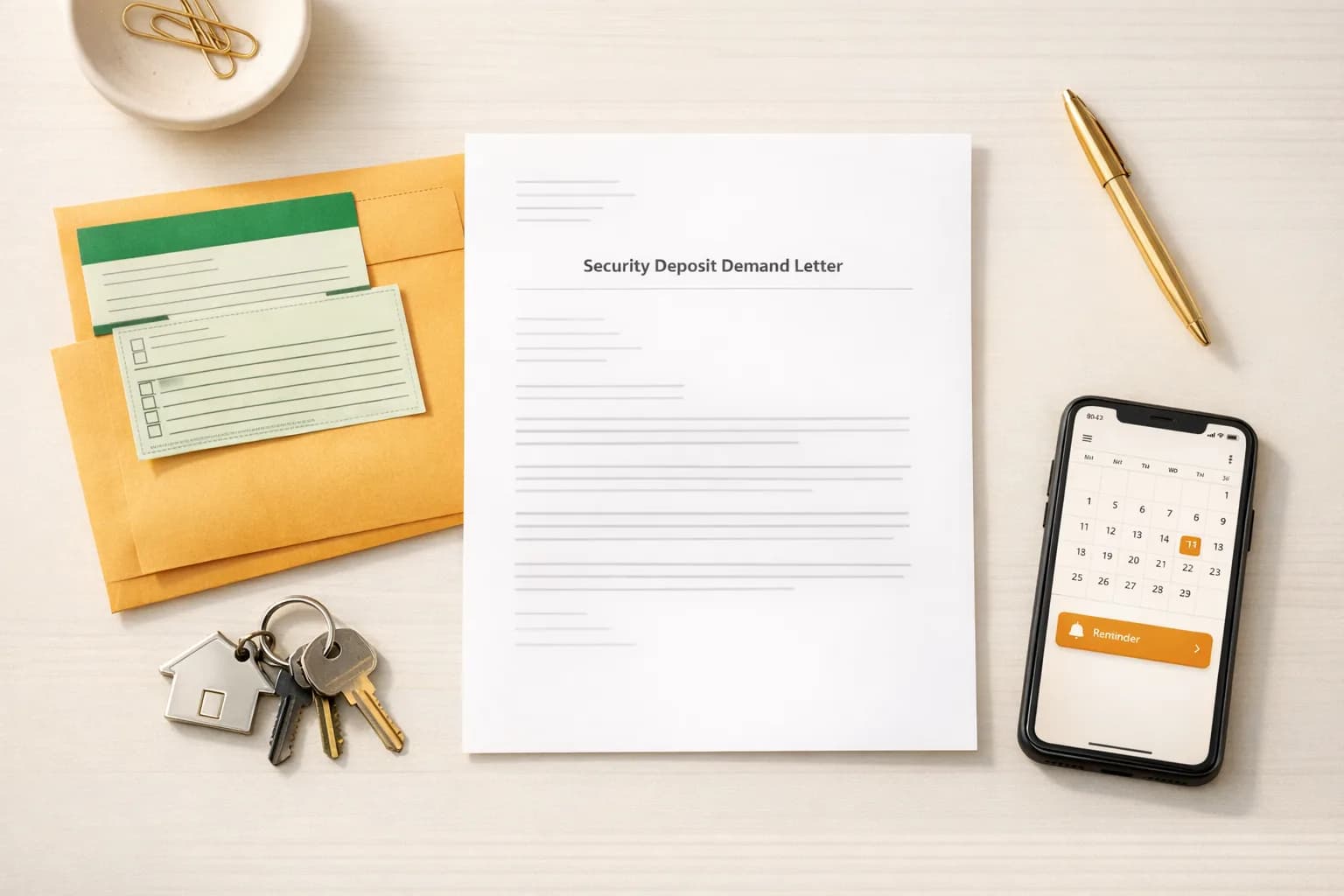
Demand Letter for Security Deposit in Texas
A practical guide to writing a Texas security deposit demand letter, deadlines to know, and when to move forward with small claims court.
If your landlord is holding your security deposit, a clear written demand is often the fastest way to get paid. It shows you know the rules, you have your facts organized, and you are ready to take the next step if needed.
This guide walks you through how to write a demand letter for security deposit in Texas, what to include, and when it makes sense to file in Texas small claims court. You will also see how Flash Justice can draft your letter and send it by certified mail with return receipt so you have proof it was delivered.
When you should send a demand letter in Texas
In Texas, landlords generally must return your security deposit within 30 days after you surrender the property and provide a forwarding address. If they keep any portion, they should provide an itemized list of deductions.
A demand letter for security deposit is usually the right move when the 30-day window has passed, or when the landlord sent deductions that look inflated, unrelated to damage, or based on normal wear and tear.
- You moved out, returned keys, and gave a forwarding address
- 30 days passed and you received nothing, or you received a partial refund without a reasonable explanation
- The landlord is charging for normal wear and tear (paint fade, minor scuffs, old carpet)
- You have photos, a move-out checklist, receipts, or messages showing the condition and your timeline
💡 Pro Tip
Send your demand letter as soon as you are eligible. Waiting months can make it harder to gather proof, and it signals to the landlord that you might not follow through.
How to write a demand letter for security deposit (step-by-step)
A strong demand letter for security deposit is short, factual, and easy to verify. Your goal is to make it simple for the landlord to pay you, and risky for them to ignore you.
If you are searching for a security deposit demand letter Texas template, focus less on fancy wording and more on including the right details and attachments.
- Your name, current mailing address, email, and phone number
- Landlord or property manager name and their mailing address
- Rental address and unit number
- Lease dates and your move-out date
- The amount of the security deposit paid
- What you received back (if anything) and the date received
- A clear demand for the amount owed and a deadline to pay (usually 7-10 days)
- How to pay you (mailing address for a check or other reasonable method)
- A sentence stating you will file in small claims court if they do not respond
⚠️ Important
Keep the tone professional. Avoid insults or threats. A judge may read this later, and a calm, organized letter supports your credibility.
What to attach and how to send it (proof matters)
Tenant rights security deposit Texas disputes often come down to proof. The more you can document your timeline and the unit condition, the more leverage you have before court.
Attach copies, not originals. Label them clearly so the landlord can see you are prepared to present the same packet in court if needed.
- Lease page showing the deposit amount (or receipt / payment record)
- Move-in and move-out photos or videos (with dates if possible)
- Move-out checklist or inspection report
- Your forwarding address notice (email, text, letter, or portal screenshot)
- Any itemized deductions the landlord provided
- Repair requests or messages that show pre-existing issues
For delivery, use certified mail with return receipt. That gives you a paper trail showing the landlord received the demand, which is helpful if you end up filing small claims security deposit.
💡 Pro Tip
If you also have an email address for the landlord, send the same letter by email after you mail it. Keep the certified mail receipt and the return receipt card or electronic confirmation.
Want a demand letter drafted and mailed for you? Flash Justice can generate your demand letter and send it via certified mail with return receipt so you have delivery proof.
Start NowWhen to file in Texas small claims court (and what to expect)
If your demand letter deadline passes with no payment or a weak response, the next step is usually small claims court security deposit Texas cases through the Justice Court. This is designed for everyday disputes, and many tenants handle it without a lawyer.
A good rule is to file when (1) you have proof you moved out and gave a forwarding address, (2) the 30-day deadline has passed, and (3) the landlord is not returning the deposit or is making unreasonable deductions.
- You can clearly explain your timeline in 2-3 minutes
- Your evidence fits in a simple packet (lease, photos, messages, receipts)
- The amount you are seeking is under the Justice Court limit (commonly up to $20,000 in Texas)
- You are comfortable with self representation tenant Texas style: showing up, staying calm, and presenting your documents
If you are filing small claims security deposit, expect a few steps: you file your petition, the landlord is served, and the court sets a date. Many cases settle after service because the landlord realizes you will follow through.
⚠️ Important
If your situation involves complicated counterclaims, serious property damage allegations, or you are unsure about deadlines and defenses, talk to a Texas attorney. Complex cases can turn on details that are not obvious at first.
A simple demand letter outline you can copy
Use this structure as a starting point. Keep it to one page when possible, and attach your proof behind it.
- Date
- Landlord name and mailing address
- Re: Demand for return of security deposit for [rental address]
- Statement of facts: lease dates, move-out date, forwarding address provided, deposit amount
- What happened: no refund within 30 days or improper deductions
- Demand: amount owed and payment deadline (example: 10 days from receipt)
- How to pay: where to mail the check or other method
- Next step: if not resolved, you intend to file in Justice Court
- Signature and contact info
A demand letter for security deposit works best when it is specific and supported by documents. If you later end up in court, the same organization helps you present your case clearly.
Conclusion: use the letter to resolve it fast, file if you must
Most security deposit disputes do not need to drag on. Send a professional demand letter for security deposit, include your proof, and give a reasonable deadline. If the landlord still does not pay, Texas Justice Court is built for exactly this type of problem.
Whether you settle after the letter or move forward with small claims court security deposit Texas filing, your biggest advantage is being organized and consistent with your facts.
**Disclaimer:** Flash Justice is not a substitute for the advice of an attorney, and does not establish an attorney-client relationship. Flash Justice does not provide legal advice and does not exercise legal judgment on your behalf. This article is for informational purposes only. If you are unsure whether small claims court is right for your situation, we recommend consulting with a licensed attorney.
Related Articles

Midland County Court Case Lookup for Justice Claims
Find a Midland County Justice Court claim, read docket updates, confirm deadlines, and request official copies with this practical guide.

Small Claims Court Tarrant County: Where and How to File
Learn which Tarrant County JP court to use, how to file your petition, what fees to expect, and what happens next.

Austin Small Claims Court: How to File in Travis County
Learn which Travis County JP court handles your claim, how to file, what it costs, and what happens after filing.