
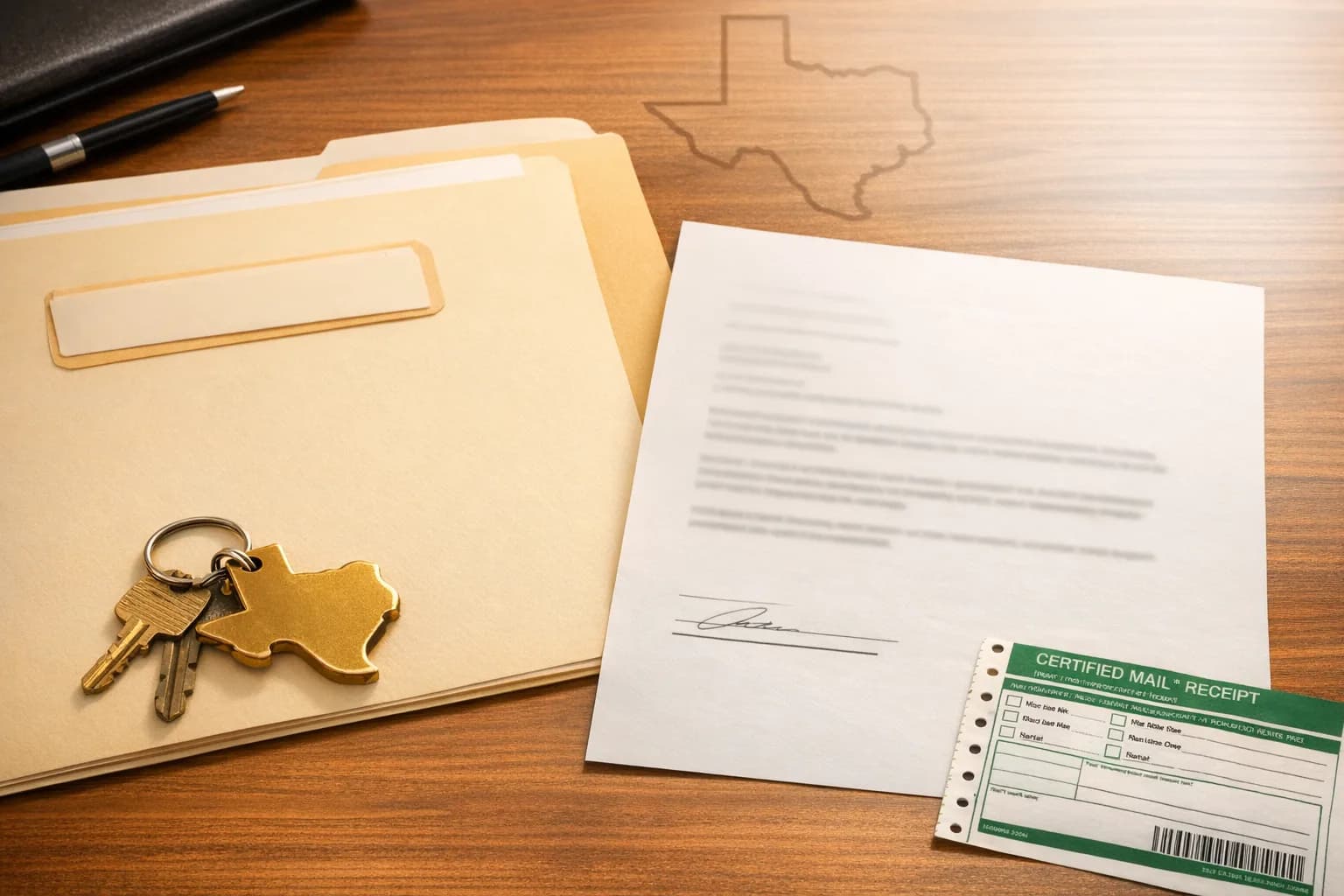
Write a Texas Security Deposit Demand Letter Fast
Step-by-step guide to a demand letter for security deposit Texas tenants can send, plus what to do next if the landlord still won’t pay.
If your landlord is holding your deposit after you moved out, a clear written demand is often the fastest way to get paid. In Texas, the rules are specific, and landlords know tenants can take them to court when they ignore them.
This guide walks you through how to write a demand letter for security deposit Texas tenants can actually use. You will also see what to include, what to avoid, and what your next step looks like if the landlord still refuses.
Texas security deposit laws: the basics to know
Before you write anything, it helps to understand the timeline. Under Texas security deposit laws, a landlord generally has 30 days after you surrender the unit to return the deposit or send a written itemized list of deductions.
A demand letter works best when it is tied to a simple fact pattern: you moved out, you gave a forwarding address, and the 30 days passed without a proper refund or accounting. That is the backbone of how to get security deposit back Texas tenants ask about most.
- The 30-day clock usually starts when you surrender possession (turn in keys and move out).
- You typically need to provide a forwarding address in writing to trigger the landlord’s duty to mail the refund or accounting.
- Normal wear and tear is not supposed to be charged to the tenant. Deductions should be for actual damages or amounts owed under the lease.
- If the landlord gives deductions, they should be specific and itemized, not vague.
💡 Quick prep checklist
Gather your lease, move-out notice, photos or video from move-in and move-out, your forwarding address proof, and any landlord texts or emails about the deposit. These make your demand letter stronger.
What to include in a demand letter (and what to avoid)
A demand letter for security deposit Texas landlords take seriously is short, factual, and easy to verify. Your goal is to make it obvious that paying you is cheaper and easier than dragging the dispute out.
Think of it like a clean demand letter template Texas tenants can reuse: who you are, where you lived, when you moved out, how much is owed, and exactly when you want payment.
- Your full name and current mailing address
- Landlord or property management legal name and mailing address (use the address for notices in your lease if possible)
- Rental property address and unit number
- Move-in date, move-out date, and the date you returned keys/surrendered possession
- Security deposit amount paid and how it was paid (attach proof if you have it)
- Forwarding address details and when you provided it (attach proof)
- What you received from the landlord (nothing, or an itemized list) and why it is inadequate (if applicable)
- Your demand: exact dollar amount and a clear deadline to pay (often 7-10 days)
- How you want to be paid (check mailed to your current address is simplest)
- A calm statement of next steps if they do not comply (for example, filing in small claims)
⚠️ Avoid these common mistakes
Do not write a long emotional story, do not threaten anything illegal, and do not guess at damages. Stick to dates, amounts, and what the law requires. A clean letter is more persuasive and easier to use later in court.
Security deposit demand letter sample: a simple structure
You do not need fancy legal language. Use this security deposit demand letter sample structure and fill in your facts. If you prefer, you can treat it as a demand letter template Texas renters can customize.
- Subject line: “Demand for Return of Security Deposit - [Property Address, Unit]”
- Paragraph 1 (who and where): “I rented [address/unit] from [date] to [date]. My security deposit was $[amount].”
- Paragraph 2 (move-out and forwarding address): “I moved out and surrendered possession on [date]. I provided my forwarding address in writing on [date] as: [address].”
- Paragraph 3 (what happened): “More than 30 days have passed. I have not received my security deposit or a proper itemized accounting of deductions.” OR “I received an accounting dated [date], but it is not itemized / includes wear-and-tear / includes charges not supported by the lease.”
- Paragraph 4 (demand): “Please mail payment of $[amount demanded] to my current address within [7-10] days of receiving this letter.”
- Paragraph 5 (next steps): “If I do not receive payment by [deadline date], I am prepared to pursue my claim in small claims court security deposit Texas procedures allow, including any amounts the court may award.”
- Closing: “Sincerely, [Name].” Include phone/email if you want, but keep it optional.
If you are unsure what to demand, start with the full deposit unless the landlord has provided a credible, itemized list. If you agree with some deductions, you can demand the undisputed portion and say you dispute the rest.
Want a certified demand letter drafted from your facts and mailed for you? Use Flash Justice to send a formal demand in minutes.
Start NowHow to send your letter so it actually works
The delivery method matters because it creates proof. If you end up in small claims court security deposit Texas cases often come down to documentation: dates, notices, and what was sent.
- Send it to the correct address: use the “notices” address in your lease, plus any known business mailing address for the property manager.
- Use USPS Certified Mail with Return Receipt if possible, and keep the mailing receipt and tracking screenshot.
- Email a copy too (if you have a known good email), but do not rely on email alone.
- Attach key proof: deposit receipt, lease page showing deposit amount, and forwarding address notice.
- Set a real deadline: pick a date on the calendar, not “ASAP.”
💡 Make the deadline easy to comply with
Ask for payment by check mailed to your current address. The easier you make it, the fewer excuses the landlord has to delay.
If the landlord still won’t pay: your next move
If the deadline passes, you have two practical options: keep negotiating with a paper trail, or file a case. Many tenants search “how to get security deposit back Texas” because the landlord goes silent after move-out, and a court filing is what forces a response.
Texas small claims (Justice Court) is designed for everyday disputes like deposits. If your landlord kept the deposit in bad faith, Texas law can allow additional amounts beyond the deposit itself in some situations.
- Organize your evidence: lease, deposit proof, photos, move-out notice, forwarding address proof, and your demand letter plus delivery proof.
- Write a simple timeline: move-in, move-out, forwarding address, 30-day mark, demand sent, deadline.
- Calculate your claim amount: deposit owed plus any clearly supported costs you paid because of the landlord’s actions (keep it simple and documented).
- Be ready to explain why deductions are improper (wear and tear, no itemization, charges not in the lease, or no proof).
⚠️ When to talk to an attorney
If your case involves serious property damage allegations, criminal claims, threats, or a large amount of money with complex facts, consider consulting a Texas attorney before filing.
Conclusion: keep it short, factual, and provable
A demand letter for security deposit Texas tenants send the right way does two things: it shows you know the timeline under Texas security deposit laws, and it creates a clean record if you have to file. Keep it brief, attach proof, and send it with tracking.
If your landlord is reasonable, a professional demand letter often ends the dispute without court. If they are not, the same letter becomes a key exhibit for small claims court security deposit Texas cases.
**Disclaimer:** Flash Justice is not a substitute for the advice of an attorney, and does not establish an attorney-client relationship. Flash Justice does not provide legal advice and does not exercise legal judgment on your behalf. This article is for informational purposes only. If you are unsure whether small claims court is right for your situation, we recommend consulting with a licensed attorney.
Related Articles

Denton County Court Records: Find a JP Small Claim
Learn how to find a Denton County JP small claims case, read its docket, request documents, and identify important deadlines.

Dallas County Case Lookup: Find a Justice Court Claim
Find a Dallas County Justice Court claim by party name or case number, read the docket, and identify your next deadline.

Kaufman County Court Case Search: Find a Justice Court Claim
Learn how to find a Kaufman County Justice Court claim, read its status, request documents, and identify your next step.