
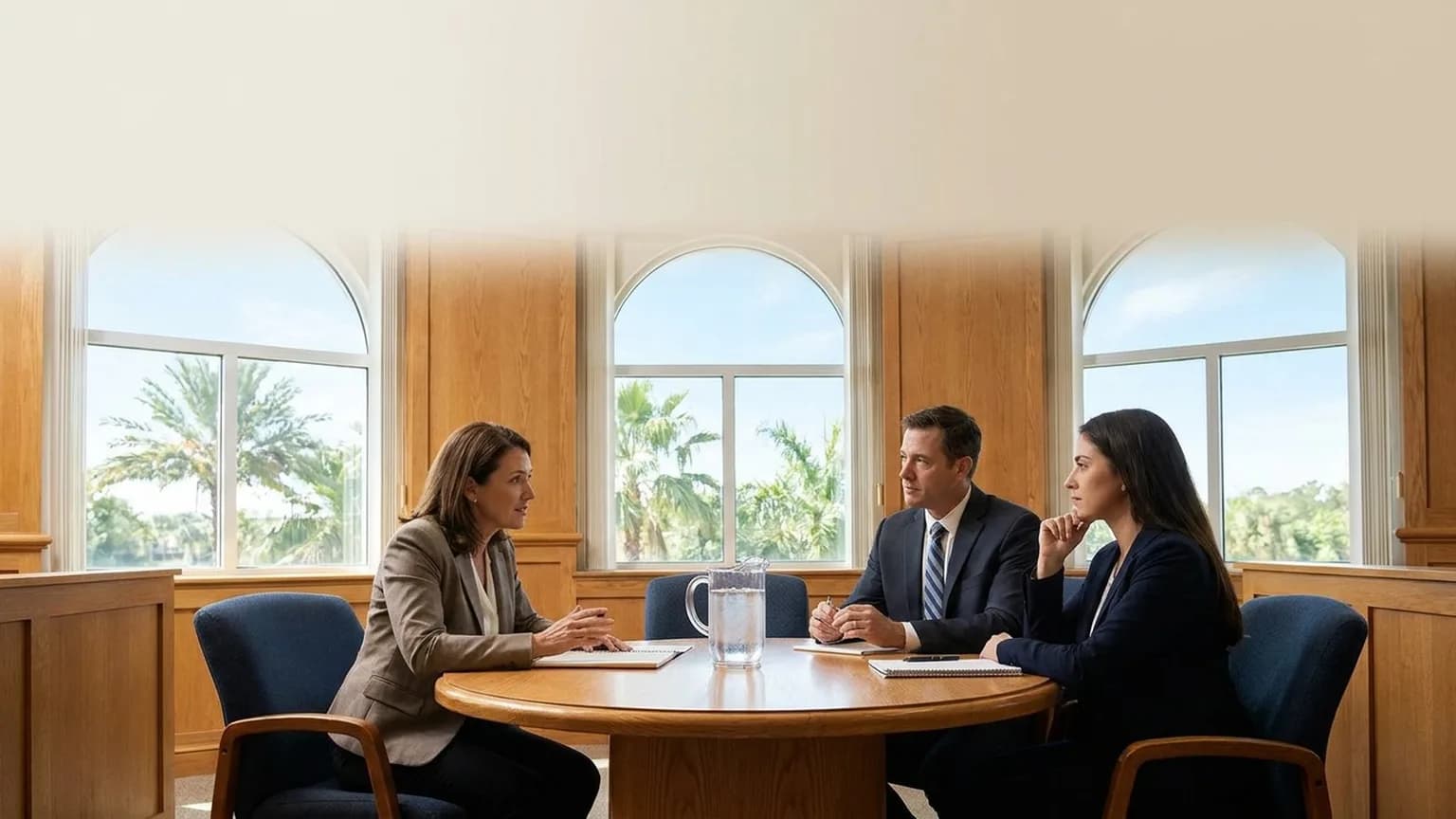
What Is Mediation in Florida Small Claims Court?
Florida small claims mediation is a confidential meeting with a neutral mediator, often at the pretrial conference; any deal must be a written stipulation.
 By Erez Vega KadochNovember 15, 20265 min read
Quick answer
Mediation is an informal, confidential meeting in which a neutral mediator helps both sides try to reach their own agreement. In Florida small claims cases, mediation may take place at the pretrial conference (Rule 7.090(f)), and any agreement must be written as a stipulation, which may be entered as a court order (Rule 7.090(g)).
The Duval County Clerk describes mediation as a process in which "an impartial and neutral third person called a mediator acts to encourage and facilitate the resolution of a dispute" without deciding what the resolution should be. Decision-making stays with the parties.
When it happens
The first court date in a Florida small claims case is a pretrial conference, set within 50 days of filing (Rule 7.090(b)). The official summons, Form 7.322, tells both sides: "Mediation may take place at the pretrial conference. Whoever appears for a party must have full authority to settle."
Under section 44.102(2)(a), Florida Statutes, courts must send many civil cases to mediation when one party asks, but that requirement does not apply to actions governed by the Florida Small Claims Rules. Section 44.102(2)(b) still allows a court to refer a case to mediation. In practice, check your summons and your county's procedures.
Who must attend, and with what authority
- Full authority: whoever appears for a party must have full authority to settle (Rule 7.090(f)).
- Attorneys: may appear for a party if they have full authority to settle without further consultation; the party then need not appear.
- Nonlawyer representatives: unless the court orders otherwise, may appear with the party's signed written authority and full authority to settle.
- Remote participation: allowed if authorized by the court or by written stipulation of the parties.
- Sanctions: failure to comply may result in costs and attorney fees incurred by the other side.
The court commentary to Rule 7.090 adds that the full-authority requirement "should not be equated to a requirement to settle" when a party wants to go to trial.
What it costs
Under section 44.108(2), the per-session fees for court-ordered mediation in some county court cases do not apply to "any small claims action." Ask your clerk if your county charges anything else.
Is it confidential?
Generally, yes. Under section 44.405, mediation communications are confidential, and a party may refuse to testify about them later. Key exceptions:
- A signed written agreement reached in mediation is not confidential unless the parties agree otherwise (sec. 44.405(4)(a)).
- Information that is otherwise admissible does not become protected just because it was used in mediation (sec. 44.405(5)).
If you reach an agreement
The agreement must be written as a stipulation, and signatures may be original, electronic or by fax (Rule 7.090(g)). For payment plans, the rules include Form 7.345, a stipulation for installment settlement under which the court keeps jurisdiction to enforce the deal. If a party fails to perform a settlement made before judgment, the court may enter judgment without notice when the creditor files an affidavit of the amount due (Rule 7.130(b)).
If you don't
The Duval clerk explains that if a full agreement is not reached at mediation, the remaining issues are set for trial. Under Rule 7.090(d), trial is set no more than 60 days after the pretrial conference, with at least 10 days' notice.
How to prepare
- Bring every document that supports your claim or defense, with copies.
- Know the lowest amount you would accept, or the most you would pay.
- Think about payment terms: lump sum, installments, due dates.
- Bring written authorization if you represent a business.
- Stay focused on facts and numbers.
Mediation and trial compared
| Mediation | Trial | |
|---|---|---|
| Who decides | The parties | The judge or jury |
| Confidential | Generally, with exceptions (sec. 44.405) | Not covered by mediation confidentiality |
| Outcome | Written stipulation | Judgment |
Related questions
Do I have to settle?
No. You must come with authority to settle, but you can decline and go to trial.
Can I bring witnesses?
The summons for the pretrial conference says not to bring witnesses, because the case will not be tried at that time (Form 7.322).
Who is the mediator?
Under section 44.102(4), the chief judge of each circuit keeps a list of mediators certified by the Florida Supreme Court, and qualified volunteers are to be appointed whenever possible.
Ready to file your Florida small claims case? Flash Justice prepares your statement of claim from your answers and files it with the court, in English or Spanish.
Start NowSources
**Disclaimer:** Flash Justice is not a substitute for the advice of an attorney, and does not establish an attorney-client relationship. Flash Justice does not provide legal advice and does not exercise legal judgment on your behalf. This article is for informational purposes only. If you are unsure whether small claims court is right for your situation, we recommend consulting with a licensed attorney.
Related Articles

How Much Can I Sue a Contractor for in Florida? Explained
Calculate Florida contractor claims for lost deposits, repair costs, property damage, related expenses, interest, and court costs.

Sue Landlord for Security Deposit Florida: Filing Steps
A Florida-specific roadmap for recovering a withheld security deposit, from filing and service through mediation and trial.

Personal Loan Demand Letter Florida: Before You Sue
Learn how to demand repayment of a personal loan in Florida, document delivery, set a deadline, and prepare for small claims.