
Texas Small Claims Limits: What You Can Sue For
Understand the small claims court limit Texas, what claims qualify, and how to calculate damages before you file.
If you are thinking about filing in Justice Court, the first question is usually simple: is your case under the small claims court limit Texas allows?
Texas small claims cases are designed for everyday disputes like unpaid money, damaged property, and broken agreements. But the amount you can ask for and the type of claim you bring both matter.
The small claims court limit Texas uses (the number that matters)
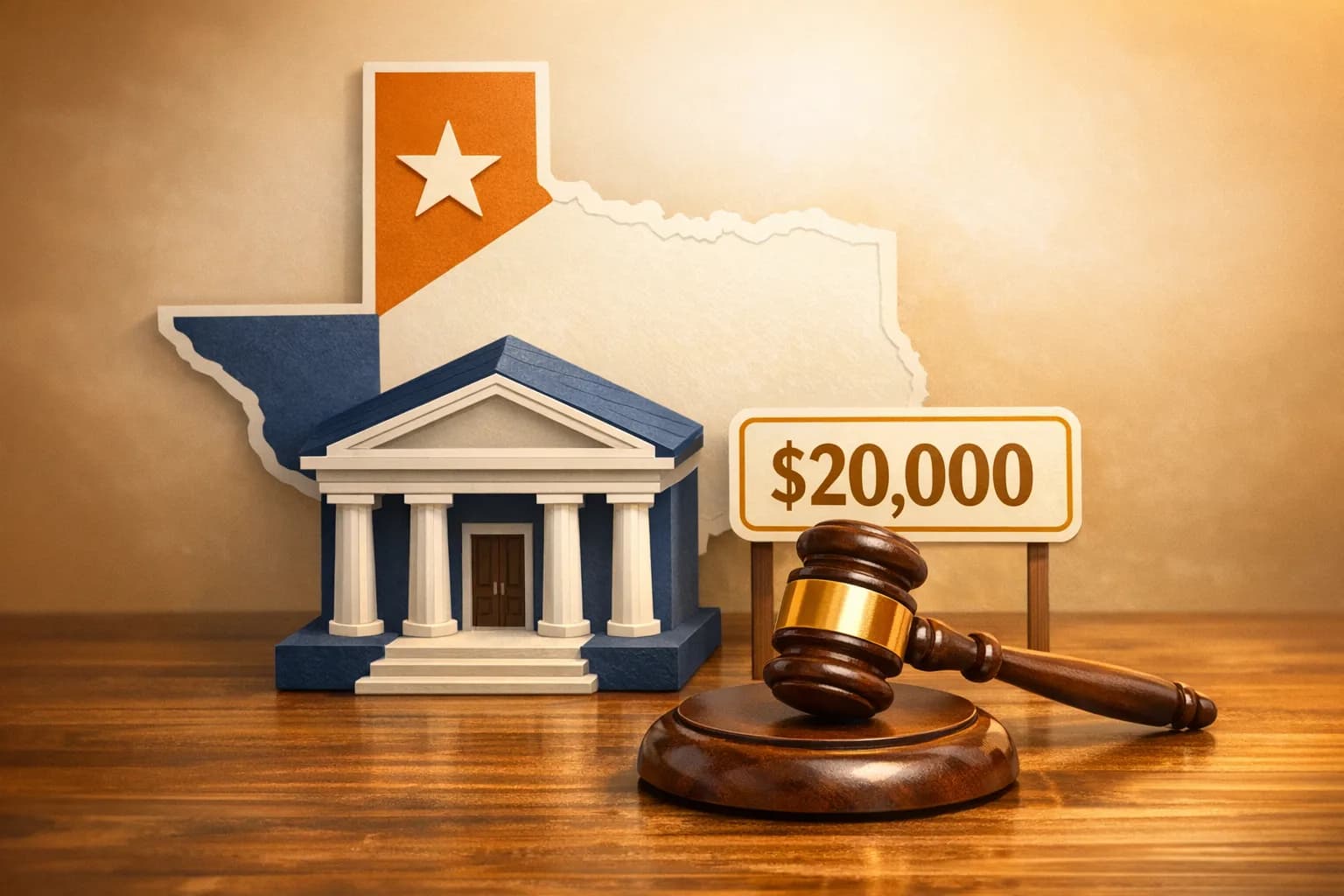
In Texas, small claims are handled in Justice Court. The Texas small claims maximum amount is $20,000.
That $20,000 is the cap on your claim for money damages. If what you are asking for is more than the small claims court limit Texas allows, you may need to reduce your claim or file in a different court.
💡 Quick rule of thumb
If the amount you want the judge to award (your damages) is $20,000 or less, you are generally within the Texas small claims court claim limits for Justice Court.
What can you sue for Texas in small claims?
People often ask what can you sue for Texas in small claims court. The simplest answer is: you can sue for money you believe someone legally owes you, up to the Texas small claims maximum amount.
Small claims is a good fit when the problem can be translated into dollars. Here are common examples that usually fit within the Texas small claims court claim limits.
- Unpaid debts and personal loans (someone borrowed money and will not pay it back)
- Unpaid invoices for services or work performed (freelance work, handyman jobs, deliveries)
- Security deposit disputes (landlord keeps a deposit without a proper reason or accounting)
- Property damage (car damage, damaged belongings, damage to a home caused by another person or business)
- Contractor and home repair disputes (paid for work that was incomplete, defective, or never finished)
- Consumer disputes (paid for a product or service that was not delivered as promised, or a refund was wrongly refused)
⚠️ Important
Small claims is usually about money damages. If you mainly want a judge to order someone to do something (like finish a job) instead of paying money, talk to an attorney about the best court and remedy.
How to calculate your amount and stay within Texas small claims court rules
To stay within the small claims court limit Texas sets, you need a clear damages number. That starts with writing down what happened and attaching a dollar amount to each part.
Think in categories, and only include amounts you can explain with documents, photos, receipts, messages, or estimates.
- Out-of-pocket costs: what you paid (receipts, bank statements, invoices)
- Repair or replacement costs: estimates, repair bills, photos of damage
- Unpaid amounts due: the exact balance owed (contract terms, invoice history, payment records)
- Consequential costs: reasonable costs caused by the problem (for example, a towing bill after a preventable incident), if you can tie it directly to the event
- Statutory damages when allowed: some claims may allow extra amounts under specific laws (this is where an attorney can help if you are unsure)
If your total is above the Texas small claims maximum amount, you generally have two practical options: file in a different court, or consider limiting your request to fit the small claims court limit Texas allows.
💡 Bring the math to court
Judges like clean numbers. A one-page breakdown with totals plus your supporting documents can make your case easier to follow.
Not sure if your dispute fits the small claims court limit Texas allows? Use Flash Justice to send a certified demand letter first and try to resolve it before court.
Start NowCommon limit questions: fees, interest, and multiple claims
When people hear the small claims court limit Texas uses, they often wonder what counts toward the $20,000. The short version is that your case should be framed so the judge can award a money amount within the limit.
Here are practical questions to think through before you file under Texas small claims court rules.
- Court costs and service fees: You may be able to ask for reimbursement of certain costs, but rules can vary by situation and what the judge awards.
- Interest: Some claims may include interest depending on the facts and any agreement between the parties.
- Multiple issues with the same person: If it is really one dispute with multiple parts, you may be able to combine them, as long as your total request stays within Texas small claims court claim limits.
- Multiple people: If more than one person caused the damage or owes the money, you may be able to sue more than one defendant, but you still need a clear theory of who owes what and why.
⚠️ Watch the calendar
Even if you are under the small claims court limit Texas allows, you can still lose if you wait too long to file. Texas has deadlines (statutes of limitation) that depend on the type of claim.
When small claims is the right tool (and when it is not)
Small claims is often the right tool when you have a straightforward story, decent proof, and a clear dollar amount that fits within the Texas small claims maximum amount.
It may not be the best fit when the case is highly technical, needs lots of witnesses, involves complex legal issues, or requires a court order other than money. If you are in that gray area, it is worth consulting an attorney.
- Good fit: unpaid money, simple contracts, property damage, deposits, refunds
- Proceed carefully: disputes with unclear proof, many parties, or complicated damages calculations
- Consider an attorney: cases involving significant injuries, complex business disputes, or unclear legal theories
If your goal is to recover money and you are within the small claims court limit Texas sets, the next step is usually organizing your evidence, calculating damages, and making a clear request for what you want the judge to award.
Many cases settle after a strong written demand. If they do not, you will be in a better position to file because you already documented the facts, the amount, and your proof.
**Disclaimer:** Flash Justice is not a substitute for the advice of an attorney, and does not establish an attorney-client relationship. Flash Justice does not provide legal advice and does not exercise legal judgment on your behalf. This article is for informational purposes only. If you are unsure whether small claims court is right for your situation, we recommend consulting with a licensed attorney.
Related Articles

Tarrant County Case Lookup: Find a Justice Court Claim
Learn how to find a Tarrant County Justice Court claim, identify the right precinct, and understand docket entries and case status.

Travis County Court Records: Find a Justice Court Case
Learn how to search Travis County Justice Court cases, read docket entries, confirm status, and request official copies.
Williamson County Court Records: Find JP Cases Online
Learn how to search Williamson County Justice Court cases, read docket entries, and request records from the correct court.