
Texas Security Deposit Laws: Get Your Money Back
A practical guide to Texas security deposit rules, deadlines, demand letters, and small claims steps to recover your deposit fast.
Getting your deposit back should be simple: you move out, return the keys, and your landlord sends your money. But in real life, a Texas security deposit often turns into a slow, frustrating standoff.
The good news is Texas has clear rules for when a landlord must send the money, what they can deduct, and what they must put in writing. If you follow a clean process and keep the right proof, you can usually resolve a security deposit refund Texas dispute without guessing.
What Texas law says about returning deposits
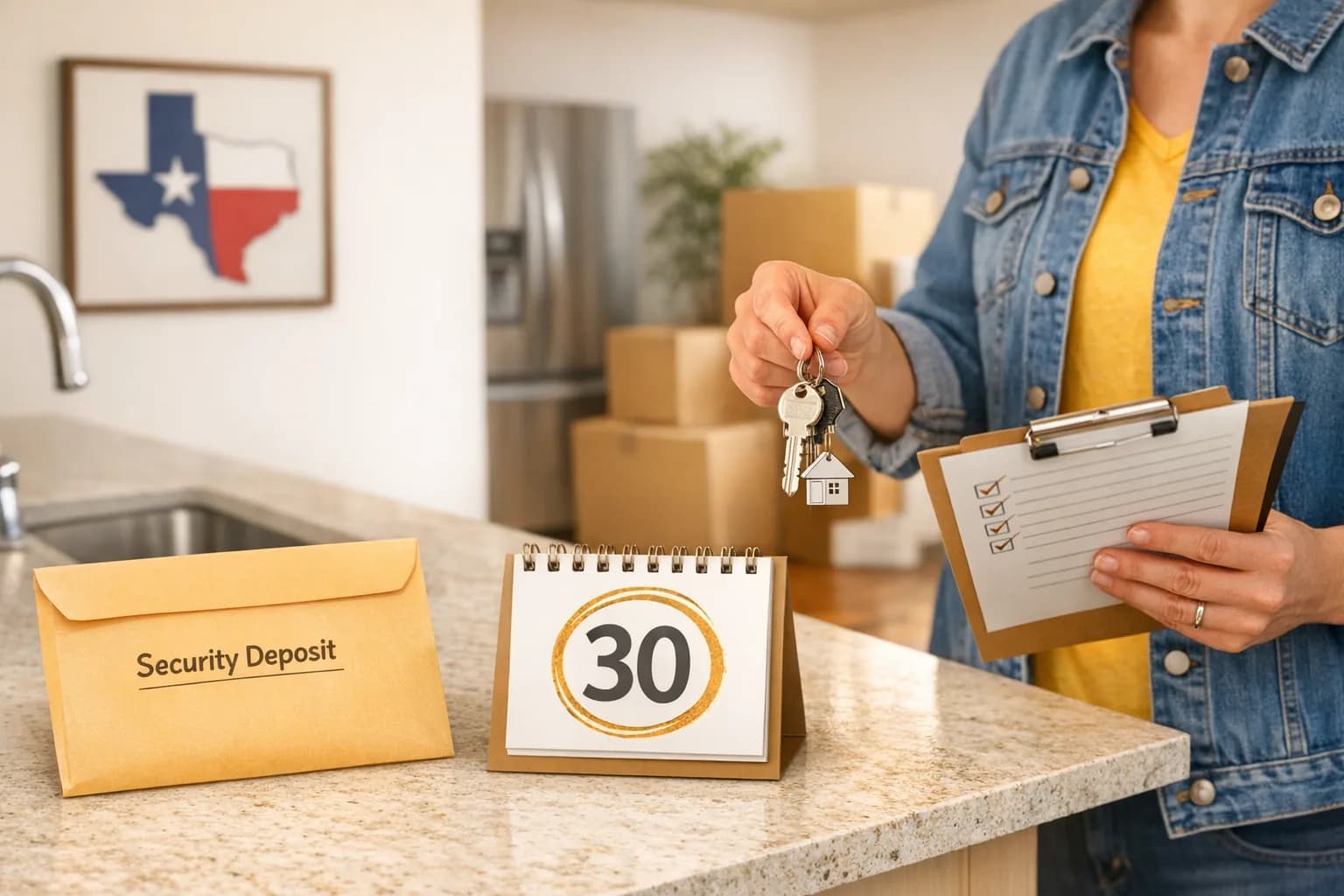
Under Texas tenant security deposit law, landlords generally must return your deposit within 30 days after you surrender the unit and provide a forwarding address. If they keep any portion, they must send an itemized written list of deductions within that same timeframe.
That timeline matters because it creates a clear paper trail. If the landlord misses the deadline or sends vague deductions, it can strengthen your position in a security deposit dispute Texas tenants bring to small claims.
💡 Quick definition
“Surrendering” usually means you have moved out, returned possession, and turned in keys or access devices. Your lease terms and your move-out communications help show the exact date.
What landlords can deduct (and what they cannot)
Most deposit fights come down to one issue: the landlord is charging you for things that are not your responsibility. In a Texas security deposit claim, the line is typically between legitimate damage and normal wear and tear.
Common deductions that are often legitimate include unpaid rent, unpaid fees allowed by the lease, and repairs for damage beyond ordinary use. Deductions that often get challenged include routine repainting, old carpet replacement, or “cleaning fees” with no proof.
- Usually fair deductions: unpaid rent, broken windows, large holes in walls, pet damage beyond normal wear, missing appliances or fixtures
- Often disputed deductions: full repaint for minor scuffs, replacing carpet that was already near end-of-life, vague “make-ready” charges, charges without receipts or photos
- Red flags: a flat fee list that looks pre-printed, no dates, no invoices, or charges that exceed the actual cost of repair
⚠️ Important
Even if your lease mentions a “non-refundable deposit,” Texas rules can still require proper accounting and lawful deductions. If you are unsure how your lease language applies, consider consulting an attorney.
How to get your security deposit back in Texas (step-by-step)
If your goal is to get security deposit back Texas style, think like a judge for a moment: you want a simple timeline, clear requests, and clean evidence. Here is a practical process that works in most cases.
- Step 1: Send your forwarding address in writing. Do it as soon as you move out. Email plus a text screenshot is good, but certified mail is stronger.
- Step 2: Save your move-out proof. Keep move-out photos and video, the date-stamped key return message, and your final utility or rent payment records.
- Step 3: Wait for the 30-day deadline. Mark the date on your calendar based on surrender and your forwarding address delivery.
- Step 4: Review the itemized deduction list. Look for missing receipts, unclear descriptions, or charges that look like normal wear and tear.
- Step 5: Ask for the refund clearly and in writing. State the amount you want back and give a short deadline to pay.
If the landlord ignores you or sends a weak deduction list, your next best move is usually a formal demand. It shows you are serious, and it often triggers settlement because it signals you are ready to file.
Ready to file for a withheld deposit? Use Flash Justice to prepare and e-file a Texas security deposit case step-by-step.
Start NowWinning a security deposit dispute in Texas: evidence that matters
Small claims outcomes usually depend on documentation, not arguments. If you are pursuing a security deposit refund Texas tenants are owed, focus on evidence that makes the story obvious in 60 seconds.
- The lease and any addenda (especially cleaning, pets, and move-out terms)
- Proof of the deposit amount paid (receipt, ledger, move-in statement, or bank record)
- Forwarding address proof (email, text, certified mail tracking, or a dated letter copy)
- Move-in condition proof (photos, video, inspection form, repair requests early in the lease)
- Move-out condition proof (date-stamped photos and video, walkthrough notes, witness text)
- The landlord’s itemized list and any receipts or lack of receipts
- Your written demand and the landlord’s responses (or silence)
💡 Make your photos work harder
Take wide shots of each room plus close-ups of high-dispute areas: floors, baseboards, appliances, bathrooms, blinds, and any place the landlord might claim damage.
Also keep your communication short and calm. A clean message like “Please return $1,500 of my deposit by Friday. The deductions listed are for normal wear and tear and no receipts were provided” is more effective than a long thread.
What you can recover in Texas if the landlord wrongfully withholds
Texas law can allow more than just the deposit amount when a landlord acts in bad faith. In many cases, tenants may seek up to three times the amount wrongfully withheld, plus a statutory $100 penalty, along with other amounts the court may allow.
That is why it is worth organizing your proof and being precise about the timeline. A Texas security deposit case is often straightforward when the landlord missed the deadline, failed to itemize properly, or charged for ordinary wear.
⚠️ Important
Not every late or reduced refund automatically means “bad faith.” The facts and the paperwork matter. If your situation involves complex lease terms, military move-outs, or large claimed damages, consider consulting an attorney.
Common mistakes that delay your refund
Most tenants lose leverage by skipping small steps early. Avoid these common problems if you want to get security deposit back Texas courts will award.
- Not providing a forwarding address in writing
- No move-out photos or only a few close-ups with no room context
- Throwing away the lease, ledger, or deposit receipt
- Arguing by phone only and leaving no written record
- Waiting months to complain, which makes the timeline messy
- Accepting vague deductions without asking for receipts or clarification
If you treat the dispute like a simple checklist, you will usually know quickly whether you have a strong claim. And if you do, you can move from “asking” to “enforcing” without wasting time.
Bottom line: Texas security deposit rules are designed to be clear. When you document your move-out, send your forwarding address, and challenge improper deductions with evidence, you put yourself in the best position to resolve the dispute or win in small claims.
**Disclaimer:** Flash Justice is not a substitute for the advice of an attorney, and does not establish an attorney-client relationship. Flash Justice does not provide legal advice and does not exercise legal judgment on your behalf. This article is for informational purposes only. If you are unsure whether small claims court is right for your situation, we recommend consulting with a licensed attorney.
Related Articles

Tarrant County Case Lookup: Find a Justice Court Claim
Learn how to find a Tarrant County Justice Court claim, identify the right precinct, and understand docket entries and case status.

Travis County Court Records: Find a Justice Court Case
Learn how to search Travis County Justice Court cases, read docket entries, confirm status, and request official copies.
Williamson County Court Records: Find JP Cases Online
Learn how to search Williamson County Justice Court cases, read docket entries, and request records from the correct court.