
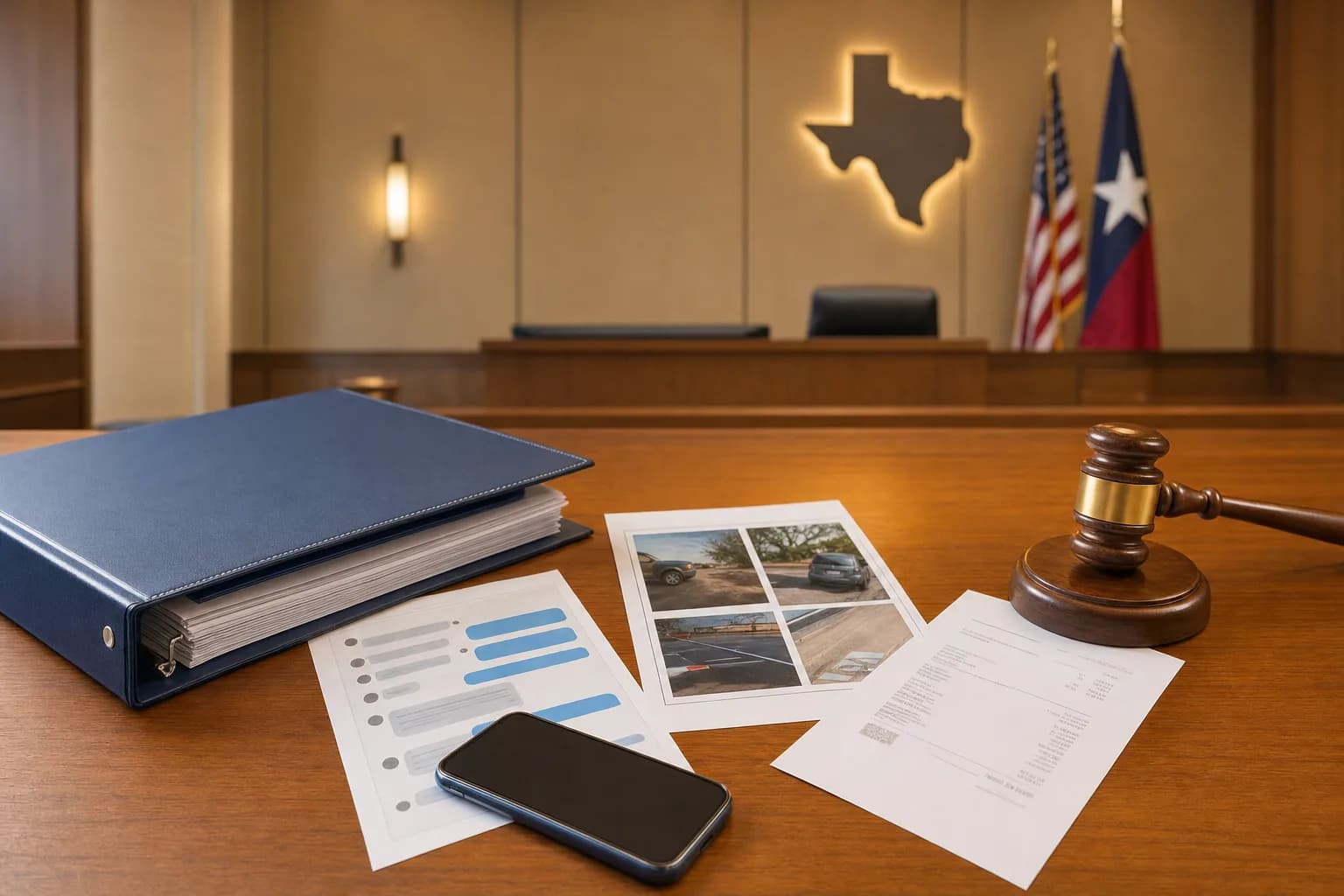
Texas Rules of Evidence: Plain Guide for Justice Court
Learn what evidence Texas Justice Courts accept and how to prepare texts, photos, records, witnesses, and objections for trial.
The Texas Rules of Evidence are relaxed in Justice Court, but evidence still must be relevant, understandable, and reliable enough for the judge to consider. You should bring organized documents, firsthand witnesses, complete digital conversations, and proof connecting each exhibit to your claim or defense.
Texas Justice Courts hear small claims and other civil disputes involving up to $20,000, excluding interest and court costs. Although these trials are designed to be accessible without a lawyer, winning still depends on proving what happened, why the other party is responsible, and how much money you are entitled to recover.
Do the Texas Rules of Evidence Apply in Justice Court?
Texas Rule of Civil Procedure 500.3 says the formal Texas Rules of Evidence generally do not apply in Justice Court unless the judge decides a particular rule is necessary to make the proceeding fair or another law or court rule requires it. This gives justice of the peace judges flexibility to consider useful evidence that might face a technical objection in another court.
Relaxed rules do not mean that everything will be accepted. A judge can limit or reject material that is irrelevant, unreliable, repetitive, confusing, unfairly prejudicial, privileged, or impossible to connect to the dispute.
What do relaxed Texas Justice Court evidence rules mean?
The judge may ask questions, clarify testimony, and focus on finding the facts instead of enforcing every technical courtroom procedure. However, you should still prepare as though you may need to establish relevance, authenticity, and reliability for every important exhibit.
A judge also may apply a formal evidence rule when fairness requires it. Local standing orders and pretrial instructions may set deadlines for exchanging exhibits, identifying witnesses, or submitting records, so read every notice from the court.
💡 The practical standard
For each exhibit, be ready to explain what it is, where it came from, whether it is complete and accurate, and what fact it proves. If you cannot answer those questions clearly, the exhibit may carry little weight even if the judge allows it.
What Small Claims Evidence Should You Bring in Texas?
The best small claims evidence in Texas creates a clear timeline and supports each part of your requested recovery. Start with the agreement, show what each side did, document the problem, and finish with evidence of the exact amount owed.
For example, a contractor dispute might require the written estimate, proof of payment, photographs of incomplete work, messages discussing deadlines, a demand for correction, and an independent estimate showing the reasonable cost to finish or repair the work.
Build an exhibit packet that proves your story
- Contracts, leases, estimates, invoices, receipts, warranties, and written payment terms
- Bank records, canceled checks, card statements, payment-app records, and other proof that money changed hands
- Photographs or videos showing property condition, defective work, damage, missing items, or repairs
- Emails, text messages, letters, voicemails, and social media messages containing promises, admissions, or refusals
- Repair estimates, replacement receipts, inspection reports, and other records supporting the amount requested
- A simple timeline listing important dates, communications, payments, deadlines, and attempts to resolve the dispute
- Witnesses with firsthand knowledge of the agreement, work, damage, delivery, payment, or conversation
Label exhibits in a logical order, such as Exhibit 1, Exhibit 2, and Exhibit 3. Add page numbers to longer documents and prepare a one-page exhibit list stating what each item proves.
Bring the original when available, along with enough readable copies for the judge, the opposing party, and yourself. Ask the court clerk about that court's exhibit practices because requirements can vary.
Follow exchange orders and protect sensitive information
Do not surprise the other party if the judge has ordered an exhibit or witness exchange. Missing a court-ordered deadline can result in delay, exclusion of evidence, or another consequence chosen by the judge.
Redact protected information from public filings and copies when required, including full financial account numbers, government identification numbers, birth dates, and information identifying minors. Follow Texas filing rules and the court's instructions, and ask the clerk about the proper procedure rather than filing an unredacted record.
How Do You Admit Text Messages in Court in Texas?
To admit text messages in court in Texas, you must show that the conversation is genuine and identify who sent the relevant messages. A contact name or phone number on a screenshot may help, but it is stronger when supported by the complete conversation, surrounding details, testimony, or another identifying fact.
Texas Rule of Evidence 901 describes authentication as presenting enough evidence to support a finding that an item is what the proponent claims it is. Justice Court procedures are less formal, but the same practical question remains: why should the judge believe this message came from that person and was not changed?
How to authenticate evidence from a phone or online account
- Capture the full conversation rather than only one favorable sentence. Include dates, times, phone numbers, usernames, and enough context to understand the exchange.
- Keep the original message on the device when possible. Bring the phone or computer to trial in case the judge wants to compare it with the printed copy.
- Explain how you received the message and how you recognize the sender. Prior conversations, a known number, a profile, writing style, or details only the sender knew can support identification.
- Connect the message to other evidence. An invoice sent immediately after the conversation or a payment matching the amount discussed can strengthen authenticity.
- Avoid editing screenshots except for clearly marked redactions required to protect private information. Cropping away context can create doubt about completeness.
Emails, social media posts, app messages, photographs, and videos require similar groundwork. A witness who took a photograph can testify when and where it was taken and confirm that it fairly shows the condition observed.
Metadata, account records, file information, or testimony from another participant may be useful when authorship is disputed. If digital evidence is central and the other party claims fabrication, alteration, account hacking, or impersonation, consider consulting an attorney.
⚠️ Do not rely on screenshots alone
Save the original digital material before trial. Deleted accounts, lost phones, disappearing messages, and incomplete screenshots can make important evidence difficult to verify.
Not sure whether your documents, messages, and damages support a Texas small claims case? Use Flash Justice's free 5-minute AI-guided case assessment. If you move forward, Flash Justice can prepare court-ready documents, e-file directly with the Texas court, and track your case.
Start NowHow Does the Hearsay Rule in Texas Affect Your Case?
Hearsay generally means an out-of-court statement offered to prove that what the statement says is true. Even under relaxed Justice Court procedures, secondhand statements may be rejected or given little weight because the original speaker is not present to answer questions.
For example, saying, "My neighbor told me the contractor admitted causing the leak," presents a hearsay problem if offered to prove that admission occurred. It is much stronger to bring the neighbor as a witness or produce an authenticated message containing the contractor's own statement.
Common hearsay issues and exceptions
The hearsay rule in Texas includes exclusions and exceptions. A statement made by the opposing party and offered against that party is generally treated differently from ordinary hearsay under Texas Rule of Evidence 801(e)(2). That can make the defendant's own texts, emails, or recorded admissions especially important.
Business records also may qualify under Texas Rule of Evidence 803(6) when they were made and kept as part of regularly conducted business activity by someone with knowledge. In more formal proceedings, Texas Rule of Evidence 902(10) allows certain business records to be authenticated through an affidavit when service and filing requirements are followed, including the rule's advance notice requirement.
- A party's own statement offered against that party
- Regularly created and properly supported business records
- A statement describing an event while the person was perceiving it
- A statement made under the stress of an exciting event
- A statement about the speaker's then-existing physical or mental condition
- Certain statements made for medical diagnosis or treatment
Whether a particular exception applies depends on why the statement is offered and the circumstances in which it was made. Do not assume that labeling a document a business record automatically makes every sentence inside it reliable, especially if the record repeats information supplied by an outside person.
Live witnesses are often stronger than written statements
A signed statement or affidavit usually is not an equal substitute for live testimony because the other side cannot question the writer. If a witness has important firsthand knowledge, ask the person to attend trial.
If a necessary witness will not appear voluntarily, Texas Rule of Civil Procedure 500.8 provides a process for requesting a subpoena. Subpoenas have service and witness-fee requirements, so contact the court early rather than waiting until the week of trial.
How to Present Evidence Clearly and Respond to Objections
Organize your presentation around the facts you must prove, not around every frustrating event in the relationship. A typical structure is agreement, performance, breach or wrongful conduct, notice, resulting loss, and the amount requested.
Begin each exhibit by identifying it. Explain where it came from, who created it, whether it is accurate, and why it matters before asking the judge to consider it.
Use a simple courtroom sequence
- Give a short overview of the dispute and state the exact amount requested.
- Testify to events you personally saw, heard, did, paid, or received.
- Introduce exhibits in date order and connect each one to a specific fact.
- Call firsthand witnesses and ask short questions focused on what they personally know.
- Explain your damages with calculations, invoices, estimates, receipts, or payment records.
- Finish by summarizing what the evidence proves and what judgment you want.
If the other party objects, stop speaking and let the judge rule. You can answer briefly by explaining the purpose of the evidence, how you know it is authentic, or why the statement is not being offered to prove its truth.
Useful plain-language objections include relevance, hearsay, lack of personal knowledge, lack of authentication, and unfair surprise under a court order. Do not interrupt every sentence or argue directly with the other party. Address the judge and explain the specific problem.
💡 Prepare for the judge's questions
Know the exact total you are requesting and how you calculated it. Judges often focus on proof of damages even when responsibility appears clear, and unsupported estimates or round numbers may not establish the amount of a judgment.
The Texas Rules of Evidence are less rigid in Justice Court, but preparation still matters. Authentic records, firsthand testimony, a complete timeline, and a clear damages calculation make it easier for the judge to understand and trust your case.
Frequently Asked Questions
Do the Texas Rules of Evidence apply to small claims court?
The formal Texas Rules of Evidence generally do not automatically apply in Justice Court. Under Texas Rule of Civil Procedure 500.3, a judge may apply a particular evidence rule when necessary for fairness or when another law or rule requires it.
Can I use screenshots as evidence in Texas Justice Court?
Yes, screenshots can be used if you can show what they are, where they came from, and why they are accurate. Preserve the original conversation, include identifying details and context, and bring the device when possible.
Can someone write a witness statement instead of coming to court?
A written witness statement may be considered, but live testimony is usually stronger because the judge and opposing party can ask questions. If the witness is essential and will not attend voluntarily, ask the court about requesting a subpoena.
Do I need original documents for Texas small claims court?
Bring original documents when reasonably available, plus readable copies for the court, the opposing party, and yourself. Copies may be accepted, but an original can help if someone challenges whether a document is complete or accurate.
Can hearsay evidence be admitted in Texas Justice Court?
A Justice Court judge may have flexibility to consider evidence that would face a formal hearsay objection elsewhere, but unreliable secondhand statements may still be excluded or given little weight. Use firsthand witnesses, authenticated party admissions, or properly supported records whenever possible.
How many copies of my evidence should I bring?
Bring enough copies for the judge, the opposing party, and yourself unless the court gives different instructions. Confirm local requirements before trial because exhibit submission and electronic evidence practices vary by Justice Court.
**Disclaimer:** Flash Justice is not a substitute for the advice of an attorney, and does not establish an attorney-client relationship. Flash Justice does not provide legal advice and does not exercise legal judgment on your behalf. This article is for informational purposes only. If you are unsure whether small claims court is right for your situation, we recommend consulting with a licensed attorney.
Related Articles
Midland County Court Case Lookup for Justice Claims
Find a Midland County Justice Court claim, read docket updates, confirm deadlines, and request official copies with this practical guide.

Small Claims Court Tarrant County: Where and How to File
Learn which Tarrant County JP court to use, how to file your petition, what fees to expect, and what happens next.

Austin Small Claims Court: How to File in Travis County
Learn which Travis County JP court handles your claim, how to file, what it costs, and what happens after filing.