
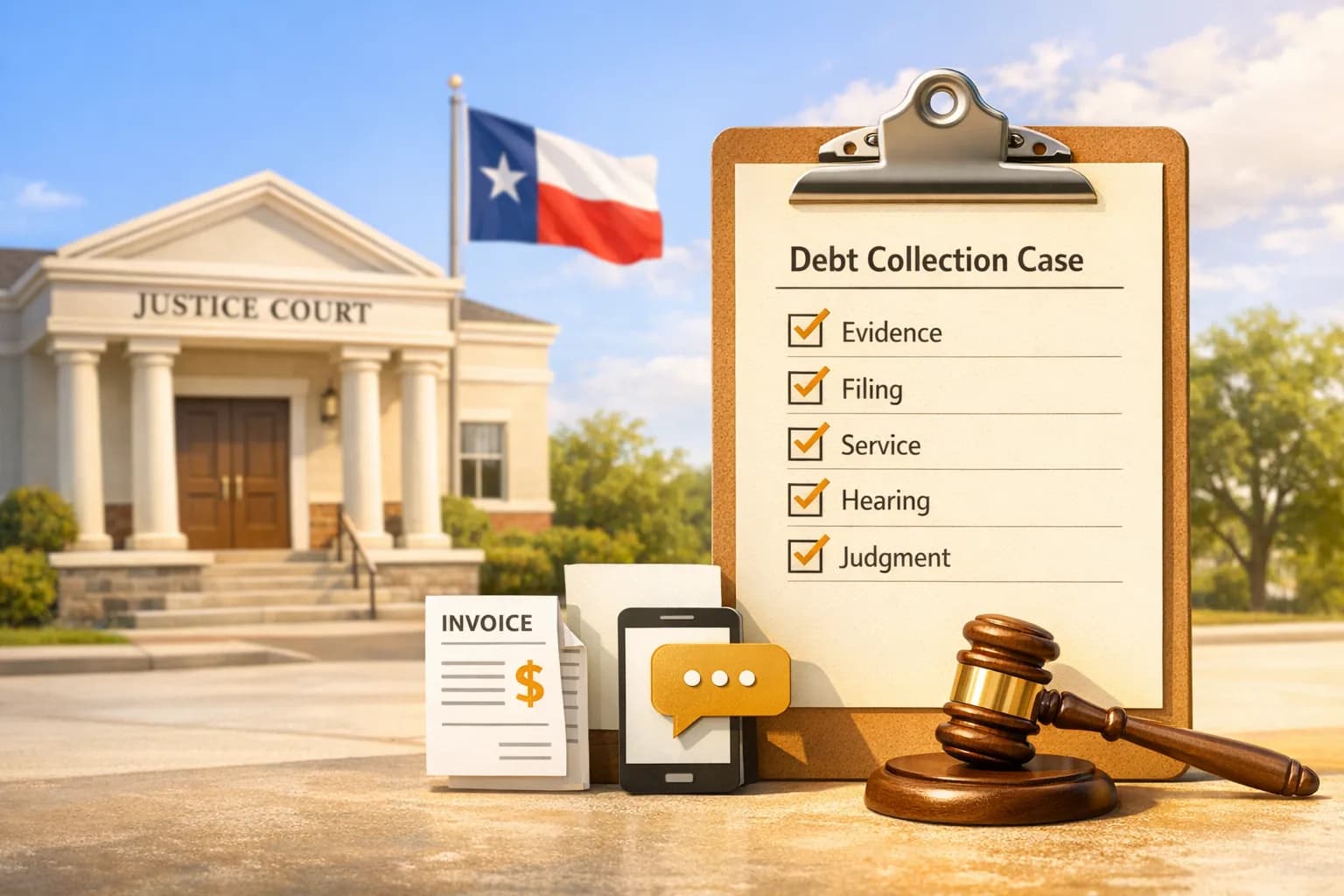
Recovering Debt in Texas Small Claims Court Guide
A practical self-help guide to debt collection in Texas small claims court, from proof and filing to service, court, and collecting after judgment.
If someone owes you money and keeps dodging you, Texas small claims court can be a straightforward way to pursue repayment without hiring a lawyer. The key is treating it like a simple business problem: prove the debt, file correctly, and follow through.
This self-help guide walks you through debt collection in Texas small claims court, including what evidence matters, how the process works, and what happens after you win. You will also learn common mistakes that can derail an otherwise solid case.
Is your debt a good fit for Texas small claims?
In Texas, small claims cases are typically handled in Justice Court. It is designed for everyday disputes, including unpaid personal loans, unpaid invoices, IOUs, and money owed for services rendered.
If you are dealing with unpaid debt small claims Texas cases often come down to two questions: (1) do you have clear proof the money is owed, and (2) can you identify the correct person or business to sue and where to sue them.
- Dollar limit: Justice Court can generally handle civil disputes up to $20,000 (not including interest).
- Type of claim: You are usually asking for a money judgment for a specific amount owed.
- Where to file: Typically where the defendant lives, where the business is located, or where the events happened (venue rules can vary).
- Time limits: Your claim must be filed before the deadline set by the statute of limitation on debt collection in Texas.
💡 Quick reality check
Winning a judgment is not the same as getting paid. Before you file, think about whether the person has wages, bank accounts, or non-exempt assets you could potentially collect from.
What you must prove in a debt collection case
Most debt collection cases are simple: you provided money, goods, or services, and the other side did not pay as agreed. Your job is to tell a clean story with documents that back it up.
If you are researching how to collect debt Texas style, focus on evidence that shows (1) an agreement, (2) performance, (3) nonpayment, and (4) the exact amount owed.
- Written agreement: contract, invoice terms, estimate acceptance, promissory note, or signed IOU
- Proof you performed: delivery confirmation, completion photos, time logs, receipts for materials, emails confirming the work was done
- Proof of nonpayment: account ledger, past-due invoice history, bounced check notice, payment app records
- Communications: texts/emails where they admit the debt, ask for time, or dispute only part of the amount
- Calculation of damages: principal owed, any agreed late fees (if documented), and interest if allowed
⚠️ Common proof problem
A handshake deal can still be enforceable, but it is harder to prove. If you do not have a written agreement, gather messages that show the amount, due date, and what they were paying for.
Step-by-step: small claims debt collection in Texas
Small claims debt collection Texas cases follow a predictable path. If you stay organized and meet deadlines, you can usually self represent debt collection Texas claims effectively.
- Step 1: Make a final written demand - Send a short letter or email stating the amount owed, why it is owed, and a clear deadline to pay.
- Step 2: Confirm the correct defendant - Make sure you are suing the right person or legal entity (individual, LLC, corporation).
- Step 3: Choose the right court and precinct - File in the proper Justice Court location based on venue rules.
- Step 4: File your petition - Clearly state the facts, the amount you want, and attach or reference key documents if allowed.
- Step 5: Serve the defendant - The defendant must be formally served according to court rules (often through a constable or process server).
- Step 6: Prepare for the hearing - Organize exhibits, print screenshots, and outline the timeline so you can explain it in minutes.
- Step 7: Attend court and present your case - Be concise, stick to facts, and focus on your proof.
- Step 8: If you win, enforce the judgment - Collection after judgment is often where the real work begins.
Texas debt collection laws Texas courts apply are very procedural. Many cases are lost because of paperwork mistakes, suing the wrong party, or failing to serve correctly, not because the debt was not real.
💡 Make your hearing easy to follow
Create a one-page timeline with dates, amounts, and references to your exhibits (Invoice 1, Text Message A, Payment Record B). Judges appreciate clarity.
Deadlines and defenses you should expect
Before filing, check the statute of limitation on debt collection in Texas for your type of claim. The deadline can depend on whether the debt is based on a written contract, an oral agreement, or another legal theory.
Defendants often raise a small set of common defenses. You do not need fancy arguments, but you do need documents and a calm explanation.
- They claim they already paid - Bring bank records, payment app history, and your ledger.
- They claim the work was defective - Bring photos, messages approving the work, and proof they accepted delivery or used the service.
- They dispute the amount - Bring the original quote, change orders, and itemized invoices.
- They say you sued the wrong party - Verify the legal name and entity status before filing.
- They argue the claim is too old - Be ready to show why the filing is within the applicable limitations period.
⚠️ When to consider talking to a lawyer
If the amount is near the limit, the facts are complicated, or you expect aggressive defenses or counterclaims, a debt collection lawyer Texas residents hire can help you evaluate risk and strategy.
After you win: turning a judgment into money
A judgment says the defendant owes you money, but it does not automatically pull funds from their account. Post-judgment collection is where many people get stuck, so plan for it early as part of your debt collection strategy.
Texas has specific rules about what can and cannot be taken to satisfy a judgment. Some assets may be exempt, and the best collection method depends on what the defendant actually has.
- Ask for voluntary payment - Many defendants pay once they see a real court judgment.
- Get payment terms in writing - If they offer a payment plan, document it and track every payment.
- Abstract the judgment (if applicable) - This can help create a lien on certain real property in some situations.
- Post-judgment discovery - In some cases you can request information about assets (rules vary by court).
- Writs and enforcement tools - Depending on the situation, you may be able to use court enforcement processes to collect.
💡 Keep your receipts
Track court costs, service fees, and enforcement expenses. Some may be recoverable, and you will want clean records if you need follow-up enforcement.
Want a faster, simpler way to file your debt collection case in Texas? Flash Justice guides you step-by-step, generates court-ready documents, and e-files directly to Texas courts with case tracking.
Start NowPractical tips to improve your odds in court
If you plan to self represent debt collection Texas cases, your advantage is preparation. Your goal is to make the judge confident that (1) the debt is real, (2) your number is accurate, and (3) you followed fair steps to resolve it before suing.
- Use plain language - Avoid long speeches and stick to dates, amounts, and documents.
- Bring three copies of key exhibits - One for you, one for the judge, one for the other side (if needed).
- Do not rely on your phone - Print screenshots of texts, emails, and payment records.
- Be consistent about the amount you are claiming - Your demand letter, petition, and hearing testimony should match.
- Stay professional - Judges notice who is organized and respectful.
Debt collection does not have to be intimidating. When you treat your claim like a file you are building, not an argument you are trying to win, you will usually present a stronger case.
If you are dealing with debt collection texas issues right now, start by gathering your proof, checking deadlines, and choosing a clear plan: settle, file, or move on. The process is manageable when you take it one step at a time.
**Disclaimer:** Flash Justice is not a substitute for the advice of an attorney, and does not establish an attorney-client relationship. Flash Justice does not provide legal advice and does not exercise legal judgment on your behalf. This article is for informational purposes only. If you are unsure whether small claims court is right for your situation, we recommend consulting with a licensed attorney.
Related Articles

Collin County Court: Where and How to File a Claim
Learn where to file a Collin County small claim, how to select the correct JP precinct, and what to expect after filing.

Denton County Court Records: Find a JP Small Claim
Learn how to find a Denton County JP small claims case, read its docket, request documents, and identify important deadlines.

Dallas County Case Lookup: Find a Justice Court Claim
Find a Dallas County Justice Court claim by party name or case number, read the docket, and identify your next deadline.