
Is Small Claims Court Worth It in Texas?
A practical guide to decide if Texas small claims is worth your time, including costs, evidence, timelines, and smart steps to take first.
If you are asking, "is small claims court worth it Texas," you are already thinking like a practical person. The real question is not whether you can file - it is whether the time, effort, and cost will likely lead to a result you can actually collect.
Small claims can be a great tool in Texas for clear money disputes under $20,000, especially when you have good proof and the other side has something to lose. But it is not magic, and it is not always the fastest path to getting paid.
What Texas small claims is (and what it is not)
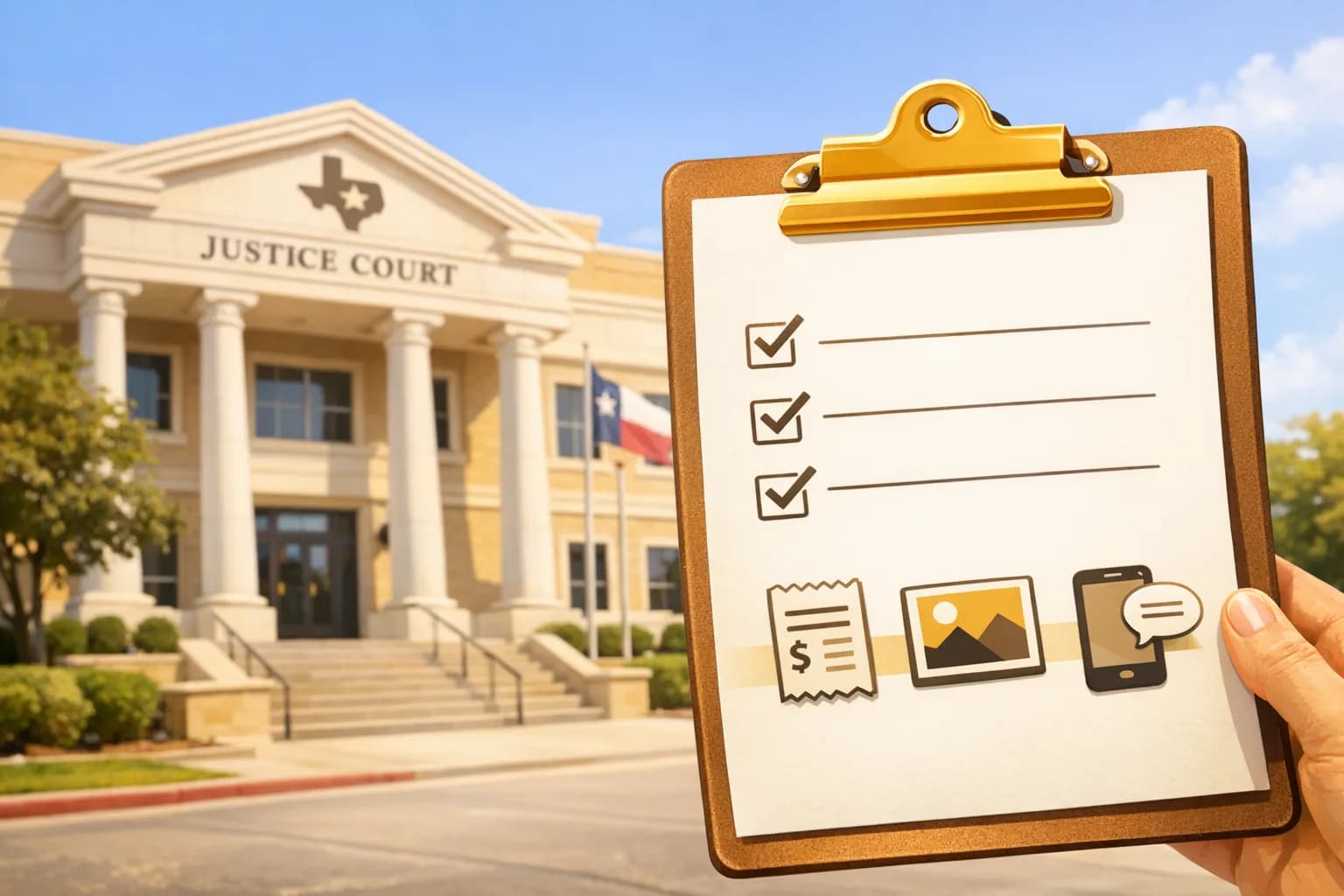
In Texas, most “small claims” cases are filed in Justice Court (also called JP court). It is designed for everyday disputes like unpaid debts, property damage, deposit fights, and contractor issues.
Small claims is usually simpler than higher courts, but you still have to do the work. You must file correctly, serve the defendant, show up, and prove your case with documents and a clear timeline.
- Typical claim types: money owed, refunds, property damage, broken agreements, security deposits
- Typical limit: up to $20,000 (not counting some court costs and interest)
- You can often represent yourself, but you still need organized evidence
💡 Texas small claims advice
Before you file, write your story in 10 to 12 bullet points with dates, amounts, and who said what. If you cannot explain it simply, a judge will have a hard time following it.
Is small claims court worth it Texas? A simple decision test
To decide whether small claims is worth it, focus on three things: proof, dollars, and collectability. If you are strong on all three, filing is often worth it.
- Proof: Do you have texts, emails, invoices, photos, a lease, receipts, or bank records that back you up?
- Dollars: Is the amount high enough to justify your time, court fees, and service costs?
- Collectability: If you win, can the other side actually pay (job, business income, bank account, assets)?
If you are still stuck on "should I file small claims Texas," try this rule of thumb. If your case is mostly about feelings, disrespect, or a messy misunderstanding with little written proof, small claims is usually an uphill battle.
⚠️ Important
Winning a judgment and collecting money are two different things. If the defendant is broke, hard to find, or constantly changing addresses, small claims may not be worth it even if you are right.
Small claims court pros and cons for Texans
The small claims court benefits Texas residents like you get are real. The process is built for regular people, and many disputes settle once the other side realizes you are serious.
- Pros: Lower cost than hiring a lawyer for full litigation
- Pros: A clear, structured process with a court date and a decision
- Pros: Strong leverage for settlement, especially with solid documents
- Pros: Works well for straightforward money disputes under $20,000
- Cons: You must spend time preparing, filing, serving, and appearing
- Cons: The judge only has what you bring - missing evidence can sink a good claim
- Cons: Collection can take extra steps after you win
- Cons: Some disputes are too complex for small claims (multiple parties, technical experts, unclear contracts)
So, is small claims court worth it Texas? It often is when the dispute is simple, the amount is meaningful, and your evidence is clean. It is often not worth it when the case is complicated, the defendant is judgment-proof, or you cannot prove your number.
Not sure whether you should file? Use Flash Justice to get a free, AI-guided case assessment and see your best next step in minutes.
Start NowWhat to do before you file (the steps that make cases stronger)
If you want Texas small claims advice that actually moves the needle, do the pre-filing work. Judges like organized people, and defendants take you more seriously when your demand is clear and documented.
- Send a clear written demand: what happened, what you want, and a deadline to pay
- Gather proof: contracts, receipts, invoices, repair estimates, photos, screenshots, call logs
- Build a timeline: date-by-date story from start to finish
- Calculate your damages carefully: be ready to show how you got your number
- Confirm the defendant’s correct legal name and address for service
Many people ask, "should I file small claims Texas or keep negotiating?" A strong written demand often settles the case without court because it shows you are prepared to file and prove it.
💡 Pro Tip
Bring three copies of your key documents to court: one for you, one for the judge, and one for the other side. Put them in the same order as your timeline.
When small claims is usually worth it (and when it usually is not)
Here are common situations where the answer to "is small claims court worth it Texas" is usually yes. These cases tend to be document-driven and easy to explain.
- You are owed a specific amount and you have proof (invoice, IOU, texts agreeing to pay)
- Property damage with photos and repair estimates
- Security deposit disputes with a lease, move-out date, and communications
- Refund disputes where you can show what you paid and what you received (or did not receive)
- Contractor disputes with a written scope, payments, and evidence of incomplete or defective work
And here are situations where small claims is often not worth it, or at least needs extra thought. The small claims court pros and cons matter most when the facts are messy.
- The other side is hard to locate or likely cannot pay even if you win
- The dispute needs an expert to explain technical issues and the proof is expensive
- You are mainly seeking punishment, pain and suffering, or a public apology
- The real issue is ongoing and urgent (like safety or access) and you need immediate court orders
- There are too many parties or the responsible party is unclear
If your situation falls into the “not sure” category, it does not mean you should walk away. It means you should tighten your evidence, consider a demand letter, and evaluate whether collection is realistic before you spend time filing.
Bottom line: make it a business decision
When people ask, "is small claims court worth it Texas," they are really asking whether the expected outcome is worth the effort. Treat it like a simple business decision: strong proof plus meaningful dollars plus a collectible defendant usually equals a smart filing.
If you are still debating "should I file small claims Texas," focus on what you can control: your documents, your timeline, and your ability to explain the case in plain language. That is where most wins come from.
**Disclaimer:** Flash Justice is not a substitute for the advice of an attorney, and does not establish an attorney-client relationship. Flash Justice does not provide legal advice and does not exercise legal judgment on your behalf. This article is for informational purposes only. If you are unsure whether small claims court is right for your situation, we recommend consulting with a licensed attorney.
Related Articles

Tarrant County Case Lookup: Find a Justice Court Claim
Learn how to find a Tarrant County Justice Court claim, identify the right precinct, and understand docket entries and case status.

Travis County Court Records: Find a Justice Court Case
Learn how to search Travis County Justice Court cases, read docket entries, confirm status, and request official copies.
Williamson County Court Records: Find JP Cases Online
Learn how to search Williamson County Justice Court cases, read docket entries, and request records from the correct court.