
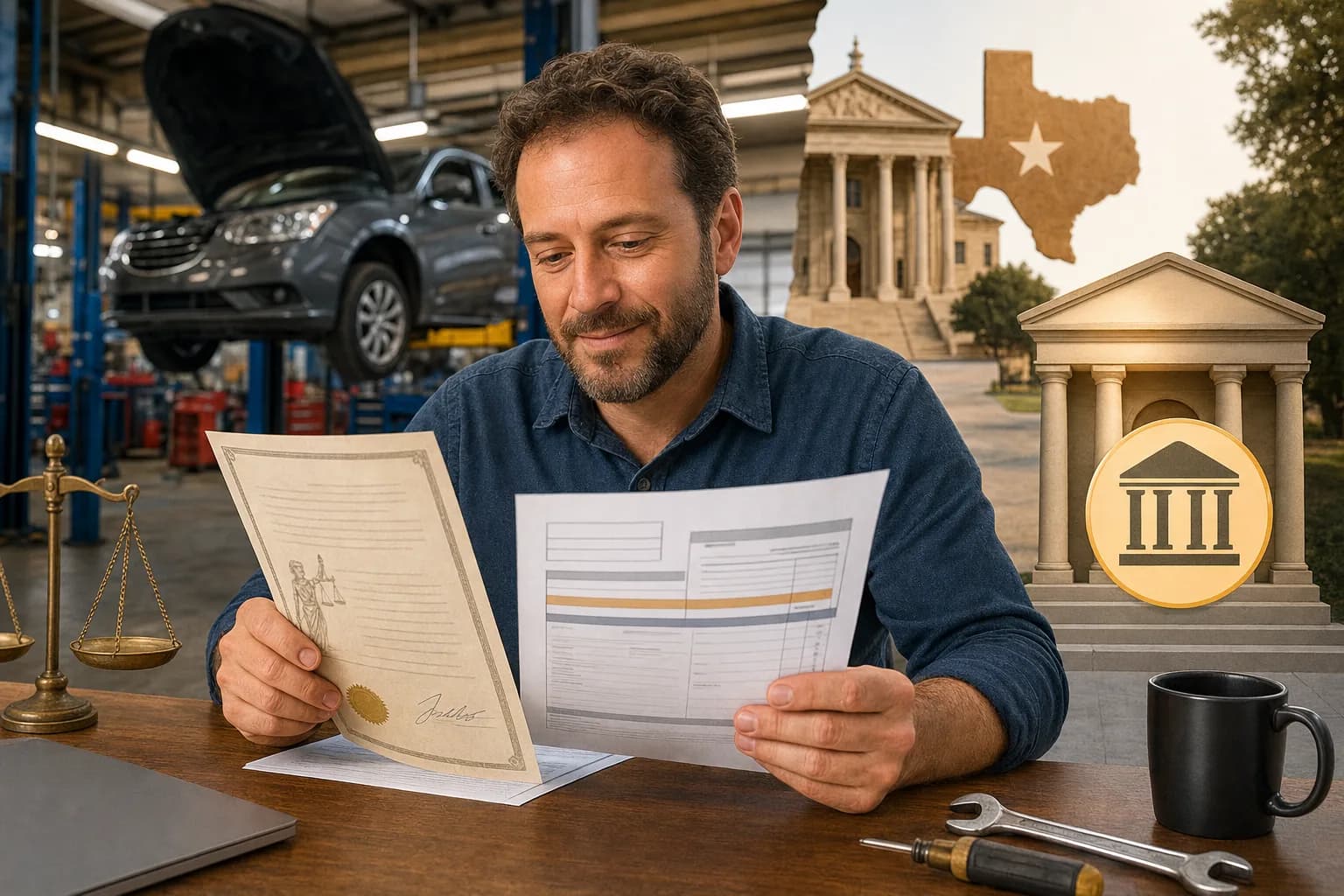
Collect Judgment From Mechanic Texas: How to Get Paid
Won your mechanic case but still unpaid? Learn Texas collection steps, from judgment liens and execution to bank garnishment.
If you searched "collect judgment from mechanic Texas," the short answer is that winning does not automatically produce payment. You may need to demand payment, confirm the shop's legal identity, locate assets, record an abstract of judgment, request a writ of execution, or pursue bank account garnishment.
These steps apply whether you won because a mechanic left your vehicle inoperable, failed to finish repairs, damaged or lost the vehicle, refused a refund, or caused transportation and corrective-repair costs. The best collection method depends on who the judgment names and what nonexempt assets that person or business owns.
How Do You Collect Judgment From Mechanic Texas Courts Awarded?
Start by reading the signed judgment carefully. Confirm the amount awarded, the judgment date, the interest terms, the court costs included, and the exact name of every judgment debtor.
Texas Justice Court does not act as a collection agency. The clerk can issue certain documents, but the person who won the case generally must choose and initiate the appropriate collection procedure.
Wait until the judgment can be enforced
A Texas Justice Court appeal generally must be filed within 21 days after the judgment is signed. The deadline can be affected by a timely motion for a new trial, motion to reinstate, or motion to set aside the judgment, so check the docket and ask the clerk whether an appeal or stay has been filed.
Texas Rule of Civil Procedure 627 generally prevents ordinary execution during the first 30 days after judgment. Do not request seizure or garnishment until you confirm that the judgment is enforceable and no appeal bond, court order, bankruptcy stay, or other restriction blocks collection.
⚠️ A Bankruptcy Filing Stops Most Collection
If the mechanic, owner, or auto shop files bankruptcy, the automatic stay usually prohibits demands, levies, garnishments, and other collection activity. Stop and consult a bankruptcy attorney before taking another step.
Send a clear request for payment
Send the debtor a written payment request with the court, case number, judgment date, current balance, and a reasonable payment deadline. Attach a copy of the judgment and explain how payment can be made.
Send it to the address used in the lawsuit and any current business address. Certified mail, return receipt requested, creates useful delivery records, although sending another demand is not normally required before using an available post-judgment remedy.
- State the original judgment amount and court costs awarded.
- Include post-judgment interest when the judgment allows it, using the applicable Texas judgment interest rate.
- Set a specific date for full payment or a written payment proposal.
- Require any installment agreement to be in writing.
- Do not mark the judgment satisfied until collected funds have cleared.
Interest can continue accruing while an auto repair shop will not pay judgment. Texas judgment rates are set under Finance Code Section 304.003 and published by the Texas Office of Consumer Credit Commissioner, so use the rate applicable to the judgment rather than guessing.
Identify the Auto Shop and Find Assets Before Collecting
The name in the judgment controls whose property can generally be pursued. A shop sign, website, invoice, or assumed name may not identify the legal person or company that owns the business.
For example, "Fast Lane Auto Repair" might be a trade name used by an individual, LLC, corporation, or partnership. A trade name is not automatically a separate legal entity, but a judgment against an LLC usually does not permit seizure of the owner's personal property.
Confirm the judgment debtor's exact legal name
Compare the judgment with the petition, citation return, repair estimate, invoice, receipt, assumed-name filing, and Texas business records. Note whether the judgment names the shop, an entity with "LLC" or "Inc." in its name, an individual owner, or multiple defendants.
This matters in a case where a vehicle owner recovered corrective-repair and transportation costs from a shop operating under a trade name. If the judgment does not clearly identify the legal debtor, do not simply levy property belonging to an owner or related company. Ask the court about available procedures or consult an attorney.
Use post-judgment discovery to locate property
Texas Rule of Civil Procedure 621a permits post-judgment discovery to identify assets. Depending on the applicable court procedures, that can include written questions, document requests, or a deposition seeking information needed to enforce the judgment.
- The legal name and address of every bank where the debtor holds an account
- Business equipment, diagnostic machines, lifts, tools, vehicles, and other property the debtor owns
- Real estate owned by the judgment debtor
- Accounts receivable and money owed to the shop by third parties
- Insurance proceeds, settlement funds, or other nonexempt money
- Existing liens or financing statements affecting the shop's assets
Public sources can also help. Review Texas entity records, county assumed-name records, county property records, appraisal district records, and Texas Secretary of State financing statement records where appropriate.
💡 Match the Remedy to a Real Asset
Do not spend money requesting every available collection document at once. If the debtor owns real estate, an abstract may be useful. If the shop owns nonexempt equipment, consider execution. If you can identify its bank, garnishment may be more direct.
If your bad-auto-repair dispute has not yet reached judgment, Flash Justice can prepare and e-file a Texas consumer refund claim for $149, with court fees and service costs separate.
Start NowHow an Abstract of Judgment Works in Texas Small Claims
An abstract of judgment Texas small claims creditors obtain is a formal summary issued by the court clerk. Recording it with the county clerk can create a lien against nonexempt real property owned by the judgment debtor in that county.
Request a certified abstract from the Justice Court that entered the judgment. Then record it in each Texas county where the debtor owns, or may later acquire, nonexempt real estate. Court and recording fees vary by county.
What an abstract can and cannot do
The abstract does not immediately transfer money to you. It can create pressure because the debtor may need to address the lien before selling or refinancing affected property.
An abstract generally does not attach to a protected Texas homestead. It also does not create a lien on property owned by someone who is not named as a judgment debtor, such as an LLC owner's house when only the LLC owes the judgment.
Texas Property Code Chapter 52 governs judgment liens. A properly recorded lien generally lasts 10 years unless it becomes dormant or is otherwise limited by law. Texas Civil Practice and Remedies Code Section 34.001 also generally provides that a judgment becomes dormant if no writ of execution is issued within 10 years after rendition, subject to revival rules.
Because names and recording details matter, review the abstract for errors before filing it. After full payment, the creditor should provide the legally required release or satisfaction so the debtor's title records are cleared.
Can You Use a Writ of Execution Against a Business in Texas?
A writ of execution against business Texas property directs a sheriff or constable to look for nonexempt property owned by the judgment debtor, levy on it, and potentially sell it to satisfy the judgment. You request the writ from the clerk of the court that issued the judgment and pay the applicable issuance and officer fees.
Execution may fit a case where a shop owes money for an unfinished repair, refund, damaged vehicle, or prolonged loss of use and appears to own valuable equipment. Possible assets include shop-owned vehicles, machinery, office equipment, inventory, or other property not protected by law or subject to superior liens.
Give the officer useful ownership information
A constable normally cannot seize property merely because it sits inside the auto shop. The property must belong to the named judgment debtor, and leased equipment, customer vehicles, employee tools, and property subject to another person's ownership claim may be unavailable.
- Provide the shop's correct legal name and physical location.
- Describe specific assets and explain why you believe the debtor owns them.
- Identify serial numbers, vehicle identification numbers, or registration information when available.
- Disclose known liens, leases, or competing ownership claims.
- Ask the officer about deposits for towing, storage, appraisal, and sale costs.
Execution costs can reduce the practical value of seizing low-value property. Repair equipment may also be financed or leased, and a lender's earlier lien may take priority over the judgment creditor.
Texas property exemptions may protect some assets
Texas provides broad exemptions for individual debtors. Property Code Chapter 42 generally protects qualifying personal property with an aggregate fair-market value of up to $50,000 for a single adult and $100,000 for a family, including certain vehicles and tools of a trade.
Those personal exemptions do not normally apply to an LLC or corporation in the same way they apply to an individual. However, ownership, secured liens, bankruptcy, and third-party claims can still prevent seizure of business property.
⚠️ A Money Judgment Does Not Automatically Recover Your Car
If the shop is still holding the vehicle, a money judgment does not necessarily authorize a constable to retrieve it. Review exactly what the judgment orders and consult an attorney if possession, title, storage charges, or a mechanic's lien remains disputed.
Can You Garnish an Auto Shop Bank Account in Texas?
You may be able to garnish auto shop bank account Texas funds if you have an enforceable judgment, identify the bank, and satisfy Texas garnishment requirements. Garnishment is a separate court proceeding against the bank, called the garnishee, rather than a simple request added to the original case.
Post-judgment garnishment generally requires a valid, subsisting judgment and a sworn application addressing the statutory grounds. One key issue is whether the debtor lacks sufficient property in Texas that is subject to execution to satisfy the judgment.
How bank garnishment works
After the writ is properly issued and served, the bank identifies funds belonging to the named judgment debtor and may freeze those funds while the court determines what should be paid. The debtor must receive the notices required by Texas procedure and can assert exemptions or challenge the garnishment.
The account name must match the judgment debtor. If the judgment is against an individual mechanic, that does not automatically permit garnishment of an LLC's account. Likewise, a judgment against the shop's corporation generally does not reach the owner's personal account.
Timing matters because a shop account may fluctuate daily. Garnishment also carries filing, service, and potentially attorney costs, and an incorrect filing can expose the creditor to liability. Consider consulting a Texas collection attorney before pursuing this remedy.
Texas generally prohibits wage garnishment for ordinary debts
Texas generally does not allow wage garnishment for an ordinary mechanic judgment. The Texas Constitution and Civil Practice and Remedies Code Section 63.004 protect current wages from garnishment except for obligations such as child support, spousal maintenance, certain taxes, and federally authorized student loan collection.
This restriction matters if the judgment is against an individual mechanic rather than the repair business. You generally cannot serve the mechanic's employer and take ordinary wages simply because you won a property-damage or refund case.
Other funds may also be exempt, including certain Social Security, veterans, retirement, and public-benefit payments. Commingled or jointly held accounts create additional complications, so do not assume every dollar in a bank account is collectible.
Close the judgment correctly after payment
Keep a running ledger showing the judgment principal, awarded court costs, post-judgment interest, credits, and collection expenses recoverable under the applicable rules. For an installment plan, state when payments are due and what happens after a missed payment.
Once the judgment is fully paid, file or provide the appropriate acknowledgment of satisfaction and release any recorded abstract as required. Texas judgment collection Justice Court procedures can vary in administration, so ask the issuing court and county clerk what forms and fees they require.
The practical path is usually to verify that the judgment is enforceable, demand payment, identify the correct debtor, locate assets, and choose one remedy tied to a real asset. Careful preparation is more effective than repeatedly contacting a shop that has already refused to pay.
Frequently Asked Questions
How long do I have to collect a Justice Court judgment in Texas?
A Texas judgment generally becomes dormant if no writ of execution is issued within 10 years after it is rendered. Because judgment liens and revival procedures have separate requirements, begin collection promptly and consult an attorney if the judgment is approaching that deadline.
Does the Texas Justice Court collect the mechanic judgment for me?
No, the Justice Court does not automatically collect your money. The clerk can issue documents such as an abstract or writ, but you generally must request the remedy, pay required fees, and provide usable information about the debtor and assets.
Can I seize the auto shop owner's personal property?
You can generally pursue only property owned by a person or entity named as a judgment debtor. If the judgment is solely against an LLC or corporation, the owner's house, bank account, and personal vehicle are usually not available without a separate legal basis.
How much does an abstract or writ of execution cost in Texas?
The cost varies by court, county, and serving officer. Ask the Justice Court about issuance fees and the county clerk or constable about recording, service, mileage, towing, storage, and sale deposits before choosing a remedy.
Can I garnish a mechanic's wages after winning?
No, Texas generally prohibits garnishment of current wages for an ordinary civil judgment. Exceptions exist for matters such as child support, spousal maintenance, certain taxes, and federally authorized student loan collection, not a typical auto repair dispute.
What if the mechanic closes the shop after judgment?
The judgment remains against the named debtor even if the storefront closes. Search for real estate, bank accounts, relocated equipment, receivables, or a successor location, but do not seize assets belonging to a different person or company without a valid legal basis.
**Disclaimer:** Flash Justice is not a substitute for the advice of an attorney, and does not establish an attorney-client relationship. Flash Justice does not provide legal advice and does not exercise legal judgment on your behalf. This article is for informational purposes only. If you are unsure whether small claims court is right for your situation, we recommend consulting with a licensed attorney.
Related Articles
Mechanic Demand Letter Texas: How to Get Your Car Back
Learn what to put in a Texas mechanic demand letter, how to send it, and when the DTPA's 60-day notice rule may apply.

How Much Can I Sue for an Unpaid Loan in Texas? Guide
Learn how to calculate a Texas unpaid personal loan claim, including principal, interest, costs, and the Justice Court limit.

Sue an Ex for Belongings in Texas: Can You Win?
Learn when withheld or destroyed belongings may support a Texas claim and how to decide whether filing is worthwhile.